
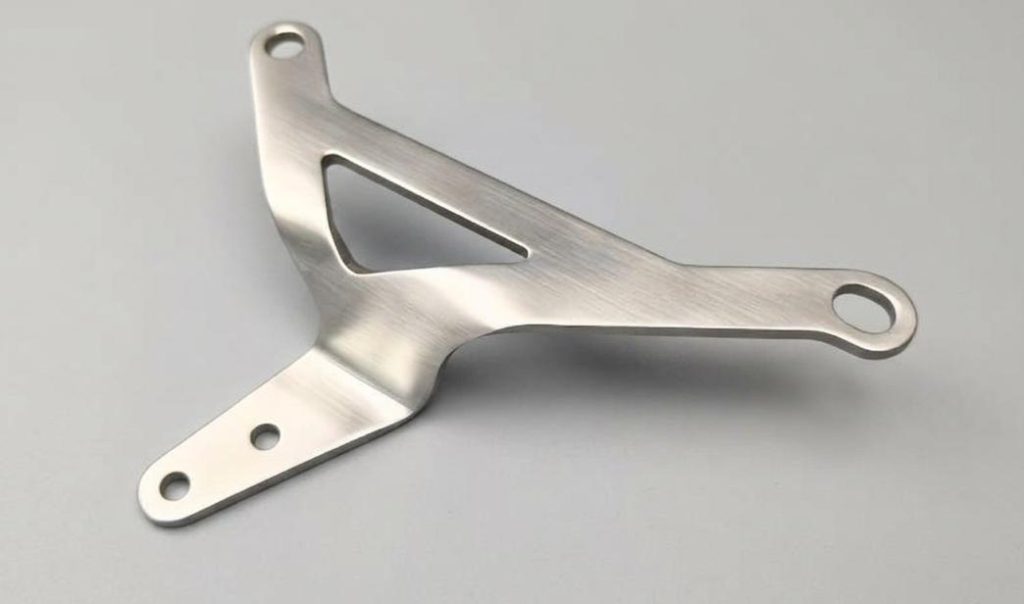
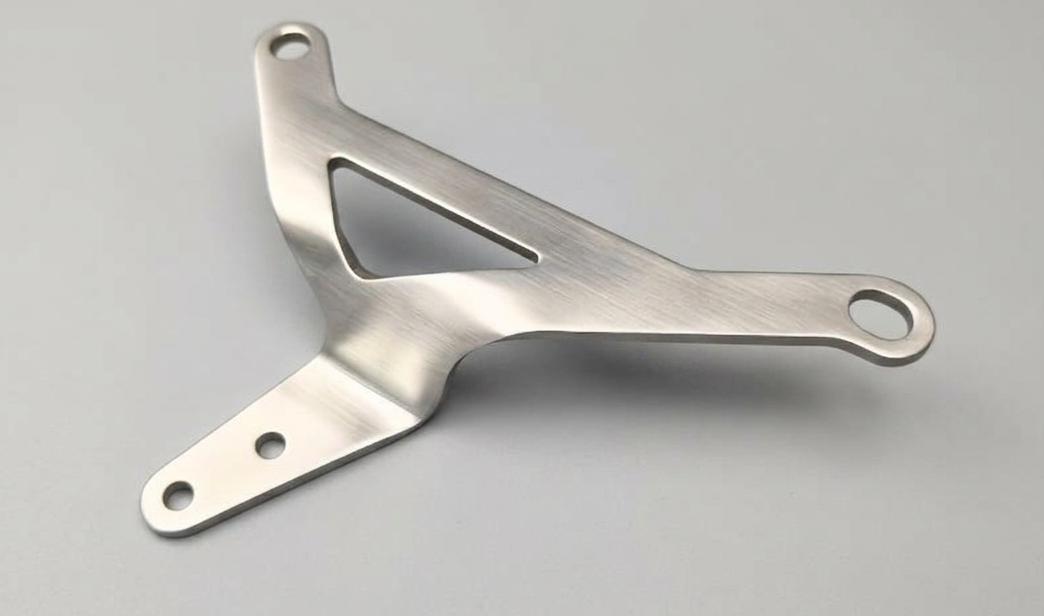
304 Stainless Steel Connection Bracket with Wire Drawing
- Material: 304 Stainless Steel
- Size: None
- Process: Laser Cutting
- Surface treatment: Wire Drawing
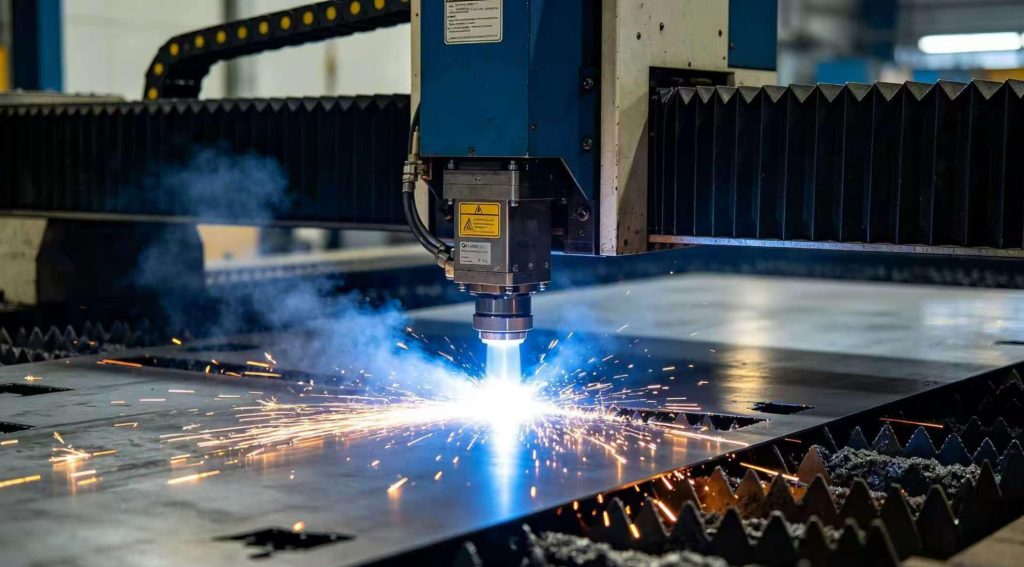
This is a custom stainless steel connection bracket produced by laser cutting and press brake bending. The process begins with laser cutting the full outer profile, triangular cutout sections, and all mounting holes from flat sheet. The part is then formed to shape on a CNC press brake, followed by wire drawing and deburring as a unified finishing step.
Machining Challenges
Multi-leg thin-plate structure with springback causing flatness issues. The part has several outward-extending leg features, which leaves the formed assembly with limited overall rigidity. Springback is present in every bend, and with multiple legs each adding their own angular recovery, the cumulative effect on overall flatness can push the part outside tolerance without specific countermeasures.
Holes distributed across pre- and post-bend zones shift after forming. The mounting holes are spread across different areas of the bracket, and several of them pass through the bending sequence after being cut. Local material stretching during bending displaces the final hole positions relative to their nominal coordinates, which directly affects alignment accuracy during assembly.
Sharp corners and cutout edges prone to burr formation. The triangular cutout sections and sharp external corners are susceptible to burr formation during laser cutting, driven by variations in the heat-affected zone and assist gas pressure around tight geometry. Burrs left on these edges affect the consistency of the brushed finish and can present a handling hazard.
How It’s Managed
| Stage | Approach |
| Cutting sequence | All holes laser cut before any bending begins, ensuring initial hole positions are established with the flat sheet as a stable reference — no subsequent forming step can shift them after the fact |
| Springback compensation | Springback angles pre-programmed into the bending sequence; dedicated positioning tooling ensures each bend produces the correct finished angle consistently across all ten parts |
| Cutting parameter optimisation | Laser power, speed, and assist gas pressure tuned specifically for the sharp-corner and cutout geometry to minimize the heat-affected zone and reduce burr formation at the source |
| Post-processing | Full deburring pass completed before wire drawing, so the wire drawing step produces a clean, consistent directional finish across the entire surface without lifting or spreading residual burrs |
Wire Drawing
Wire drawing leaves uniform, fine directional lines across the stainless steel surface — more practical than a mirror finish for parts that see regular handling, since it’s far less prone to showing fingerprints and minor contact marks.
For a connection bracket in an external or semi-exposed position on a piece of equipment, the brushed surface combines lasting corrosion protection with a clean, professional appearance that holds up well in service.