
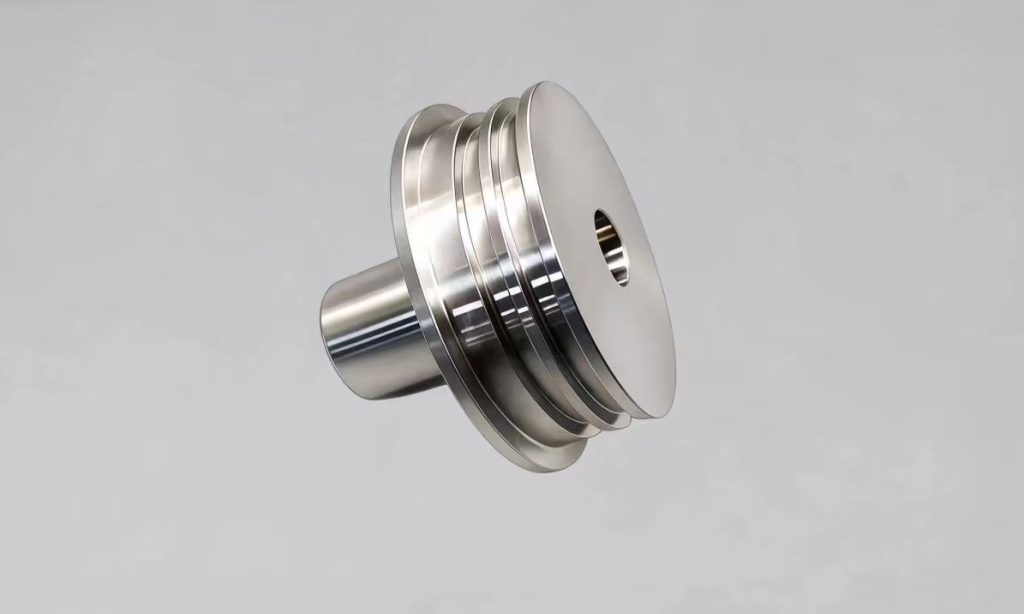
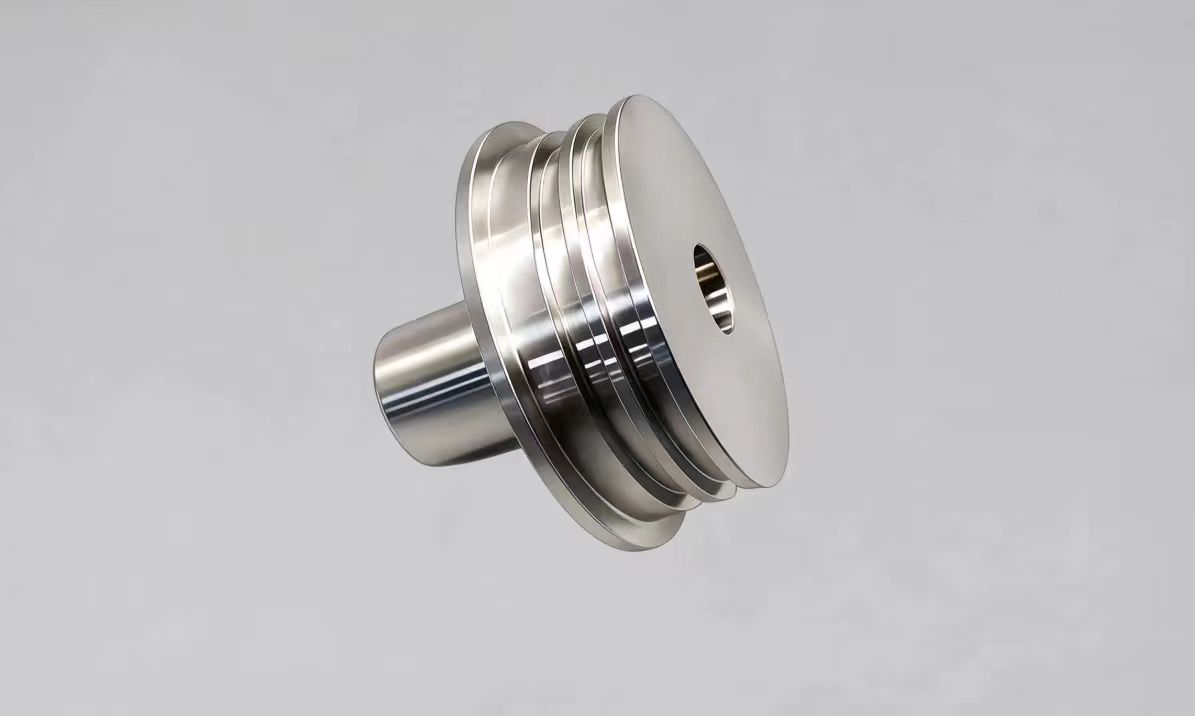
316 Stainless Steel CNC Turned Stepped Shaft Wheel
- Material: 316 SS
- Size: D63.50X50.29 mm
- Process: CNC Turning
- Surface treatment: None
Part Overview
This is a CNC-turned stepped shaft wheel with a coaxial rotational design: a slim shaft journal on one end, several ring-shaped sealing grooves in the middle, and a large disc flange on the other end with a through hole in the center. The whole part is turned in one go, finishes with a clean surface, and resists acids, alkalis, and corrosion.
Following the Process, Step by Step
Step 1: Rough turning, and keeping sticking under control.
316 stainless is highly ductile and tough, so the material readily welds onto the cutting edge. That roughens the surface, makes burrs likely at the roots of the seal grooves, and makes the groove corner radius and width harder to hold. So from the very first cut we use grooving tools made for stainless steel and coated turning inserts, keep the cutting speed down, and flood the cut with coolant so built-up edge has no chance to form.
Step 2: After roughing, let the part rest.
316 does not conduct heat well, so turning heat stays concentrated in the cutting zone and leaves machining stress inside the part. If we went straight from roughing to finishing, the dimensions would often drift after the part was done. So after roughing, we hold the part at temperature and let it rest until the stress has settled, and only then move on to finishing.
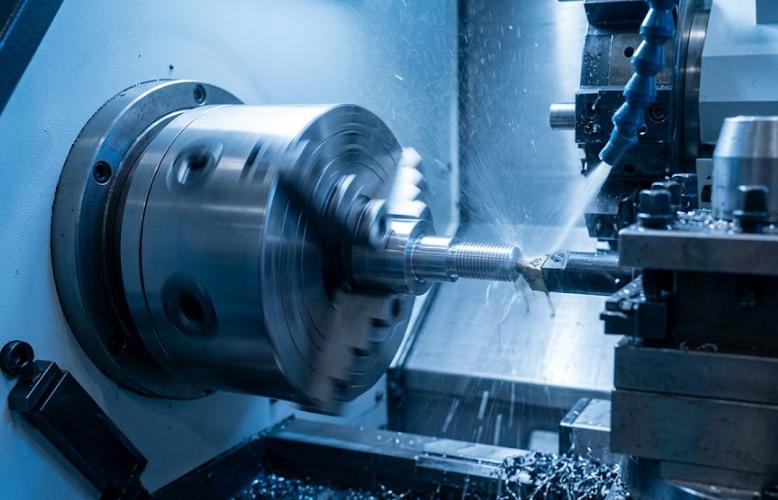
Step 3: Finish turning the profile and protecting coaxiality.
This part has many steps and many ring grooves, and every section needs tight coaxiality. The safest approach is to complete as much as possible in a single setup. When the part has to be flipped, we use soft jaws and align during the finish turning pass, establishing the datum first so the second setup does not introduce error.
Step 4: Cutting the seal grooves without chatter.
The ring grooves are narrow, and the grooving tool is slim and not very rigid, so any carelessness makes it chatter and leaves ripples on the groove walls. We cut the grooves in layers, taking a very shallow cut each time to reduce cutting resistance, and leave a finishing pass for the groove bottom so both the walls and the floor come out smooth.
Step 5: Measure only after the part has cooled.
A freshly turned part still carries heat, and a measurement taken then is not accurate. We wait until the part has cooled down before inspecting it, so the numbers we read reflect its true size.
Where It’s Used
316 stainless steel has strong corrosion resistance, so this part is often found in fluid valve assemblies, pump bodies, medical equipment, and seawater or chemical processing conditions. It works as a rotary valve core, sealing wheel, or drive locating component with sealing ring grooves. An O-ring sits in each groove to form a dynamic seal.