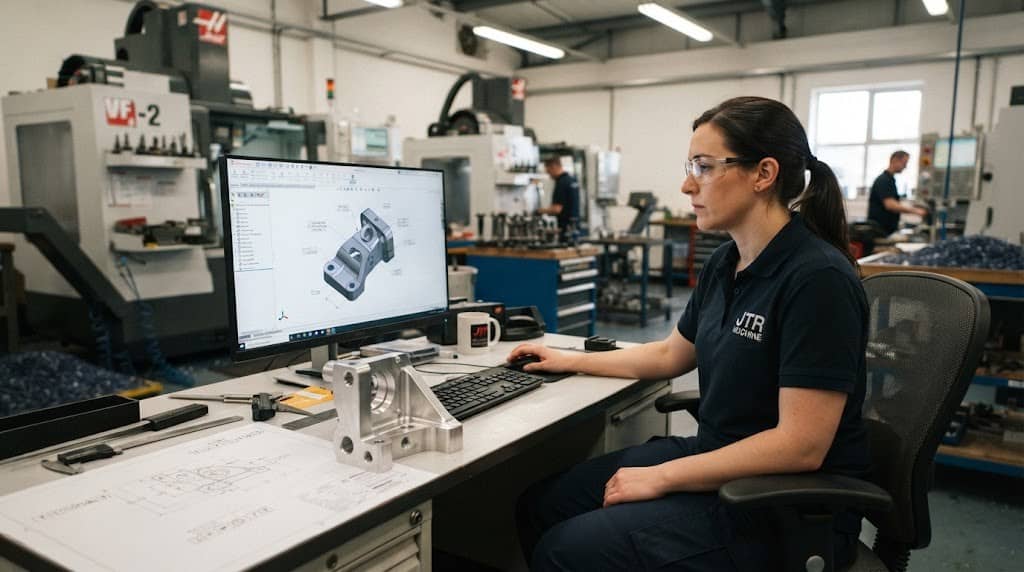


The housing of an electric vehicle motor is more than just a protective enclosure; It supports the bearing and stator, serves as an alignment fixture and point-of-mounts, and may be part of the motor’s cooling system. These functions link housing design and manufacturing closely. However, an “external” housing, while out of spec in the stator bore, bearing seats, or cooling channels, may assemble perfectly and generate misguided misalignments of bearing seats and spec bore problems, even leak test failures.
For EV manufacturers and engineering teams, CNC machining EV motor housings is a matter of controlling the features that impact assembly, motor performance, and heat management. In this guide, we review material, machining, tolerance, and inspection considerations when developing a CNC machined motor housing.
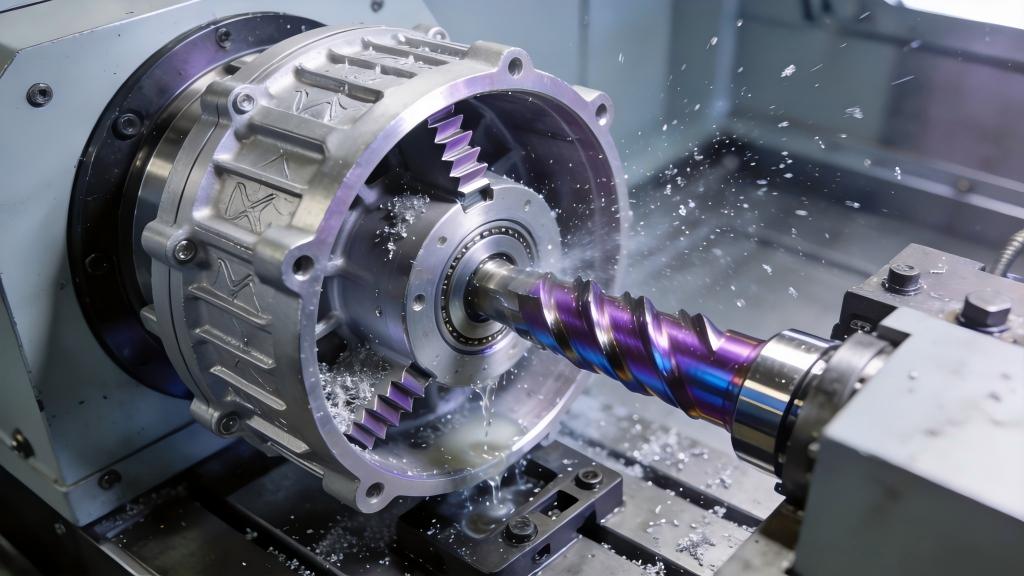
Key Structural Features of an EV Motor Housing
An EV motor housing combines several functional features. Each has different manufacturing requirements.
| Housing feature | Main function | Machining consideration |
| Stator bore | Locates and supports the stator | Diameter, roundness, and surface condition |
| Bearing seats | Support the rotor shaft through bearings | Diameter, fit, and coaxial alignment |
| End-cover interface | Connects the housing and end cover | Flatness, hole position, and sealing |
| Mounting flanges | Secure the motor to adjacent components | Hole position and datum consistency |
| Cooling jacket | Circulates coolant around the motor | Channel geometry, wall thickness, and leak integrity |
| Sealing surfaces | Prevent fluid leakage | Surface finish and dimensional consistency |
The stator bore and bearing seats are especially important because they influence the alignment of rotating and stationary components. Their dimensions should be assessed against the relevant assembly datums, not treated as isolated measurements.
The design should also provide enough tool access for machining and inspection. This matters around deep bores, internal channels, and recessed mounting features.
Choosing the Right Aluminum Alloy for EV Motor Housings
Aluminum is a popular material for electric motor housings due to its light weight, corrosion resistance, machinability, and some thermal benefits. But there is no universal alloy that is best for all applications. It is contingent upon the processing route and mechanical loads, geometry, and thermal requirements.
| Material | Potential advantages | Points to evaluate |
| 6061 aluminum | Good machinability and strength | Temper, structural loads, and cost |
| 6063 aluminum | Commonly used for extruded profiles | Profile geometry and strength requirements |
| ADC12 aluminum | Suitable for complex die-cast shapes | Casting quality, porosity, and machining allowance |
For example, 6061 may be considered for CNC-machined prototypes or structural components, while ADC12 may suit complex housings produced through die casting.
Material selection should not rely on thermal conductivity alone. Mechanical strength, corrosion resistance, casting characteristics, dimensional stability, and joining requirements also matter. The final choice should match the motor’s operating conditions and engineering drawing.
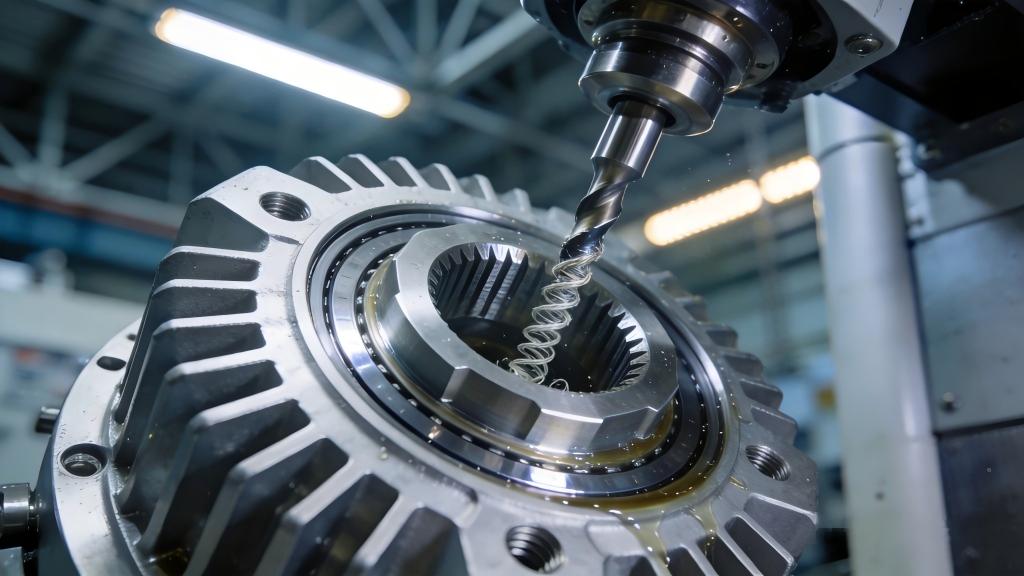
CNC Machining Processes for EV Motor Housings
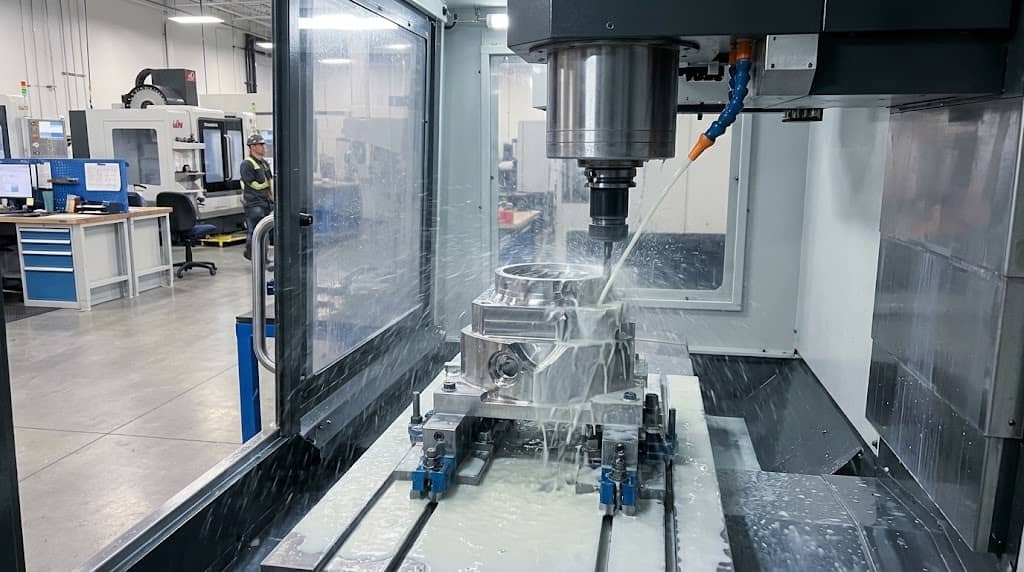
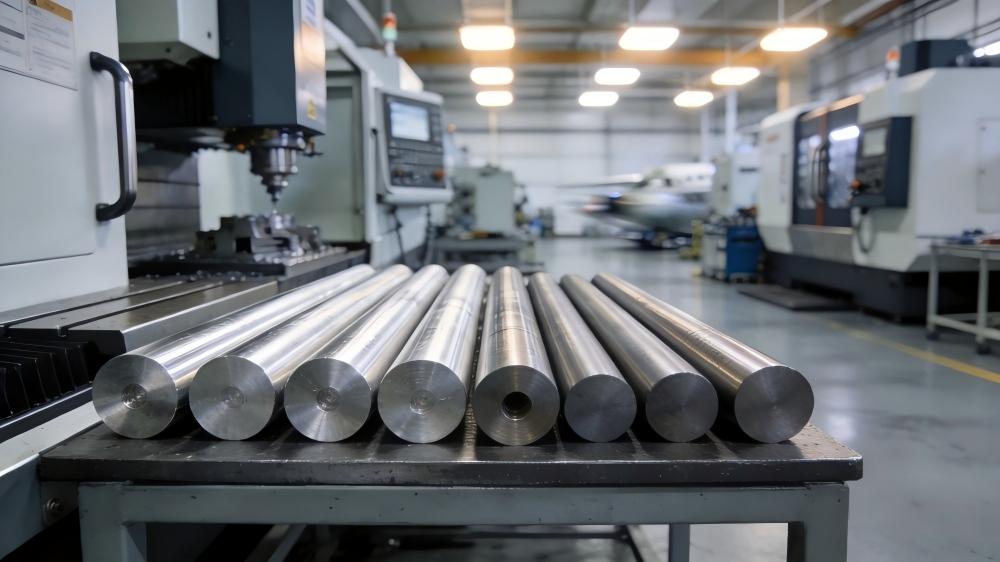
Fabrication methods include machining the housing from solid stock, forming from an extruded part, or die-casting.
Typical CNC machining steps may include:
- Material preparation: Selection of aluminum grade and machining of the blank.
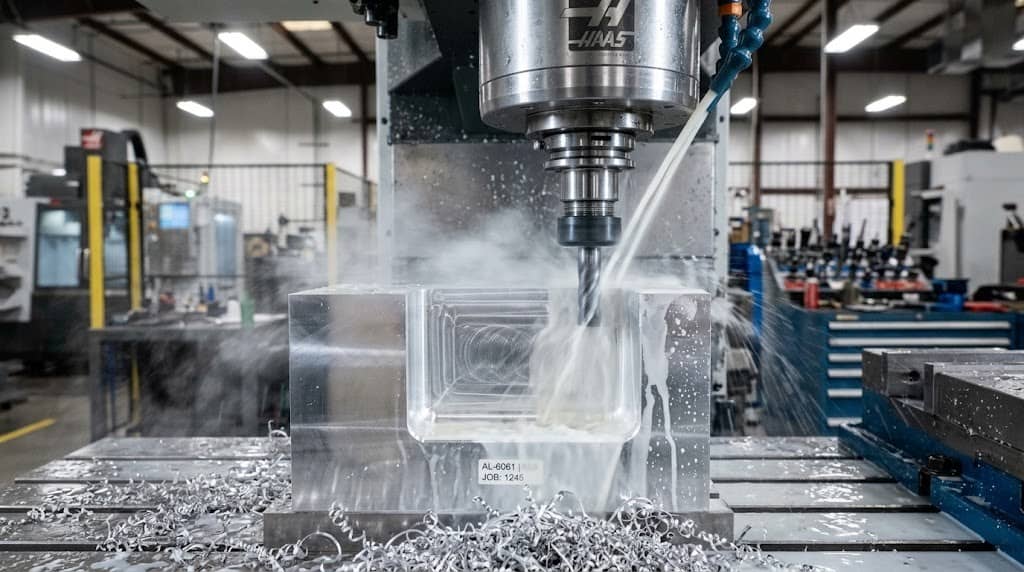
- Preliminary machining: Remove the excess material to establish the initial shape.
- Semifinishing: Set up a rough finish in critical areas for finished machining control.
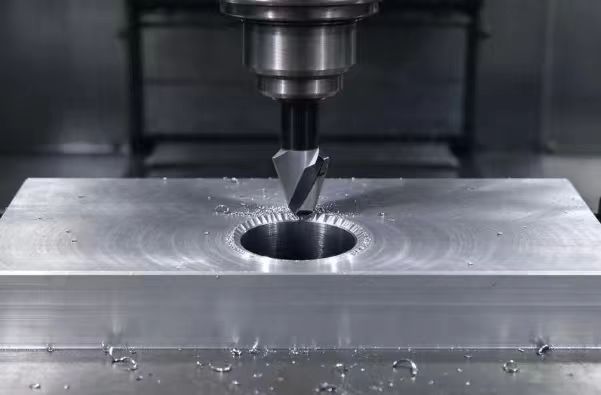
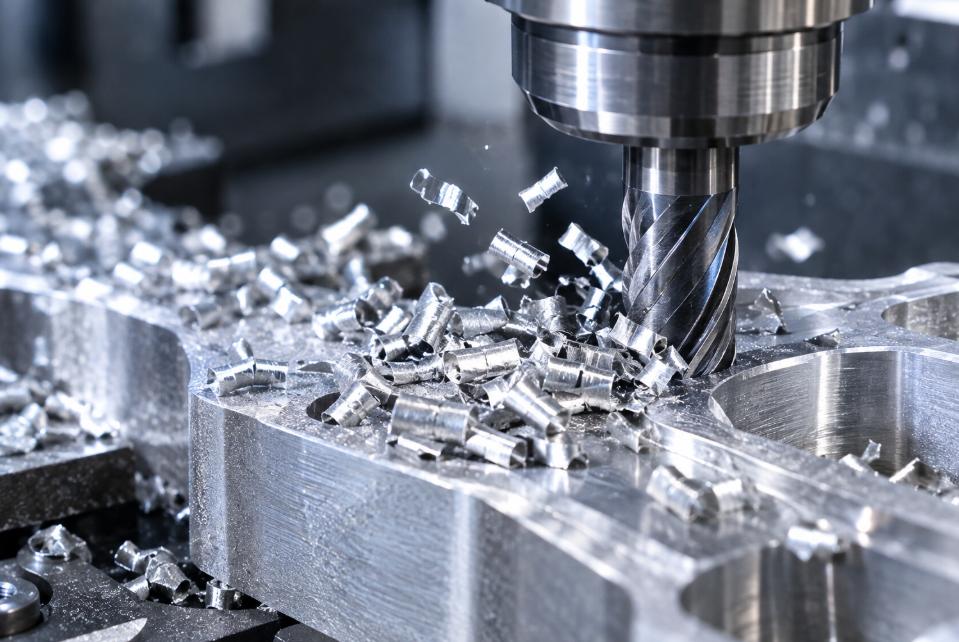
- Finishing: Finish out stator bore, bearing seats, mounting faces, and seal contact faces.
- Deburr and clean: Eliminate chips and sharp edges, especially in and around holes and channels.
- Checking: Compare dimensions to drawing and any functional requirements.
Multi-axis machining may also do away with the need to re-set for convoluted surfaces. It can also maintain relationships between features on separate faces. The relationship of features to datums and the accessibility of features will also play into choosing the proper machining strategy, as will whether five-axis equipment will even be necessary on a part or not. Some housings are best machined on a 3-axis or index multi-axis machine.
Learn more in JTR Machine’s 3-axis, 4-axis, and 5-axis CNC machining guide.
Critical Tolerances in EV Motor Housing Machining
Not every dimension on a motor housing needs the same tolerance. Critical dimensions are those that affect assembly, alignment, sealing, and functional performance.
Common examples include:
- Stator bore diameter and roundness: Affect the stator’s fit and positioning.
- Bearing seat dimensions: Determine whether bearings can be installed with the required fit.
- Coaxiality between bearing seats: Helps maintain rotor alignment.
- Mounting-hole position: Affects installation and connection with adjacent components.
- Flange flatness: Influences contact between mating surfaces.
- Sealing-face finish: Can affect gasket or other sealing performance.
Apply different tolerances for each of these features. The tolerance needs to be selected based on the engineering drawing, fit requirements, method of assembly, size of the part, and operating conditions. For example, a bearing seat may need to be dimensionally/geometrically tighter than an external cosmetic surface. Non-functional features may not need tight tolerances, and specifying them can increase the cost of machining and inspection for no gain in performance of the motor.
A practical inspection plan may use:
| Feature | Possible inspection method |
| Bore diameter | Bore gauge or suitable internal measuring instrument |
| Bearing-seat alignment | CMM or specified geometric measurement method |
| Mounting-hole position | CMM or dedicated inspection fixture |
| Flange flatness | CMM or surface measurement equipment |
| Surface roughness | Surface roughness tester |
The measurement method should match the drawing requirement and the feature being evaluated.
Thermal Management: How Housing Design Affects Heat Dissipation
That motor heat is generated by all of several sources which induce electrical losses in the windings and mechanical losses in the moving parts. The housing aids in moving heat away from internal parts. Also creates a path for liquid-cooled designs to run coolant.
Typical cooling designs include:
- External cooling fins: Increase the surface area of heat exchange.
- Liquid-cooling jackets: Circulate coolant around certain sections of the housing.
- Internal cooling passages: Place coolant channels near high-heat areas.
- Integrated cooling structures: Connect external and internal passages.
The design of channels is as important as the material in a liquid-cooled housing. Channel location, cross-section, wall thickness, flow distribution, and sealing design can influence cooling performance. CNC machining requires attention to the geometry for cooling design. Over-removing may lead to the weakness of walls of channels, and poor machining around ports or sealing faces may be the risk of leaking.
Just because thermal conductivity is good does not mean that cooling the motor is an easy task. The result also depends on the flow of the coolant, the design of the channels, the thermal contact between components, and the actual load on the motor. The thermal conductivities vary depending on the die-cast aluminum alloy (see research). This is one reason to test the selected alloy against all thermal and mechanical requirements. Refer to this study of thermal conductivity in high-pressure die-cast aluminum alloys.
Common Machining Challenges and How to Prevent Them
Several issues can affect EV motor housing quality during machining.
| Common issue | Possible cause | Process consideration |
| Bore deformation | Clamping force or uneven material removal | Review fixture support and machining sequence |
| Bearing-seat misalignment | Multiple setups or inconsistent datums | Plan datum references and setup strategy |
| Poor surface finish | Tool wear, vibration, or unsuitable cutting conditions | Select appropriate tooling and finishing operations |
| Cooling-channel leakage | Casting defects, machining damage, or sealing issues | Define channel inspection and leak-test requirements |
| Hole-position deviation | Setup variation or workpiece movement | Use controlled positioning and suitable inspection |
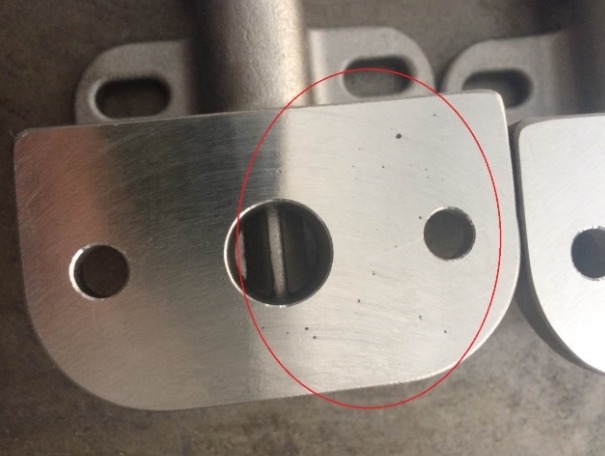
For cast housings, the machining plan should also account for casting variation and possible porosity. Critical machined features need sufficient material allowance. The casting should be evaluated before expensive finishing operations begin.
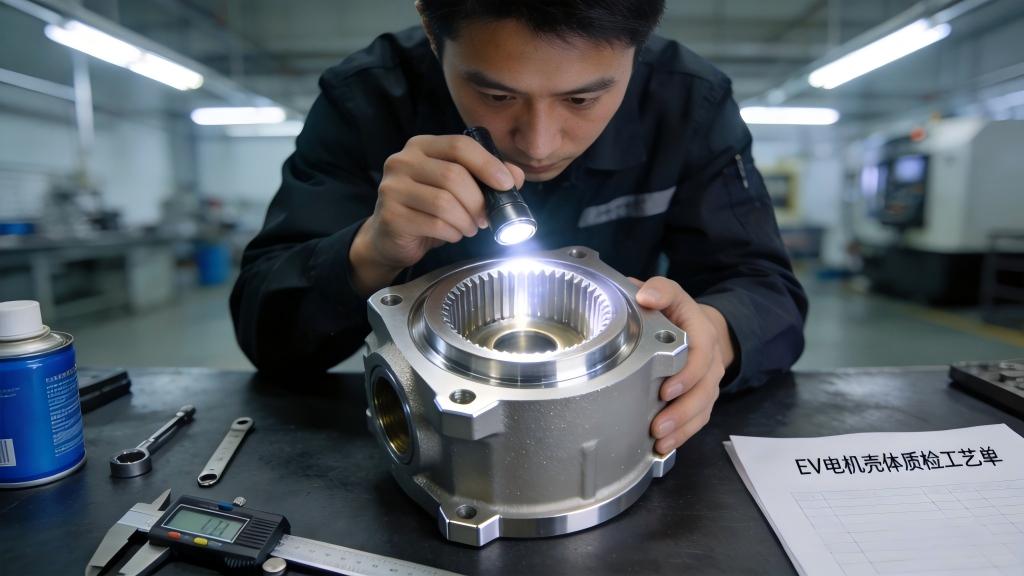
Quality Inspection for CNC Machined EV Motor Housings
A quality inspection plan brings together all the main requirements from the drawing with appropriate measures or tests.
Activity flow may look like this:
Drawing review → Material verification → CNC machining → Dimensional inspection → Surface inspection → Leak testing, when required → Final inspection.
Dimensional inspection confirms that measured features comply with the drawing. It does not prove that a cooling jacket is leak-free by itself. However, specific leak-test methods and acceptance criteria should be agreed to and defined prior to the production of housings with liquid-cooling passageways. The test medium, pressure, time, and inspection method should be as per customer specification and within design limits of the component.
Depending on the project, inspection may include:
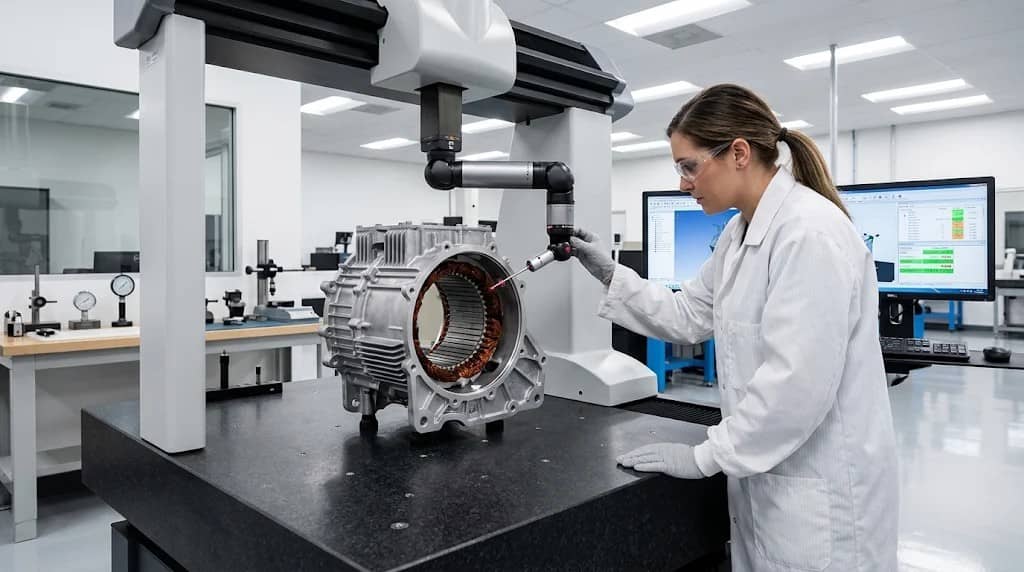
- CMM measurement of critical dimensions and geometric relationships.
- Bore and thread inspection.
- Surface roughness checks on specified interfaces.
- Visual inspection for burrs, scratches, and machining defects.
- Leak testing of coolant passages and sealing areas.
A useful quality plan prioritizes the dimensions and functions that determine assembly and operating performance.
CNC Machining vs. Die Casting: Which Is Better?
CNC machining and die casting serve different production needs. They can also be combined.
| Consideration | CNC machining | Die casting + CNC finishing |
| Initial tooling | Usually lower for prototypes | Requires casting mold investment |
| Design changes | Generally easier to accommodate | Mold changes may add time and cost |
| Complex near-net shape | Depends on tool access and material removal | Suitable for complex cast geometries |
| Critical interfaces | Machined directly from stock | Critical surfaces can be finish-machined |
| Production planning | Useful for prototypes and lower-volume needs | Often considered for repeat, higher-volume production |
For early development, CNC machining can help teams validate housing dimensions and assembly interfaces without committing to a production mold. For repeat production, die casting followed by CNC finishing can combine near-net-shape manufacturing with precision machining of critical features. This approach may reduce material removal while retaining control over bearing seats, bores, and mounting surfaces.
The best route depends on annual volume, part geometry, alloy, tooling budget, and dimensional requirements. A drawing review is more useful than choosing a process based on volume alone.
JTR provides die casting services alongside CNC machining, allowing the manufacturing route to be evaluated against the part’s design and production needs.
Working with a China CNC Machining Service for EV Motor Housing Projects
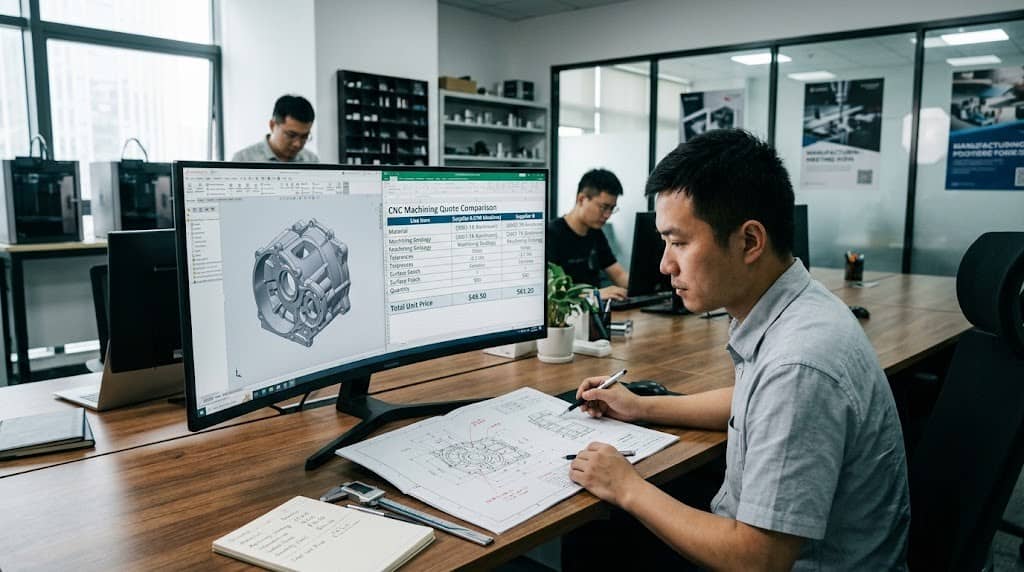
Choosing a manufacturing source involves more than calculating the price per unit. Since EV motor housings can have many functional features that are interrelated, the supplier needs to understand the drawing and its machining datums, material requirements, and inspection plan.
When evaluating a China CNC machining service, consider these points:
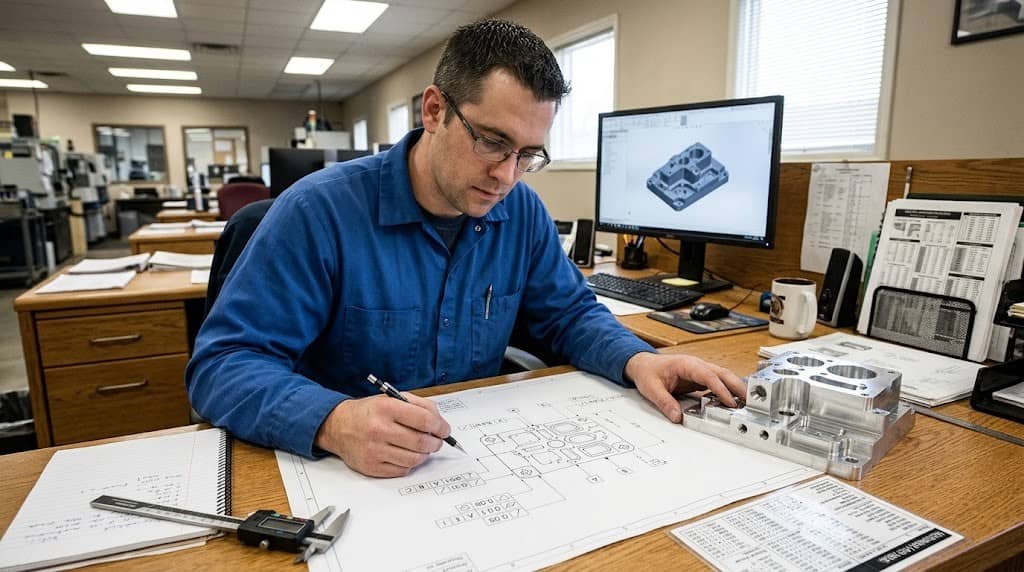
- Can the supplier review 2D drawings and 3D CAD files before quoting?
- Can the team identify critical bores, bearing seats, and sealing surfaces?
- Does the supplier have suitable CNC milling and multi-axis machining capabilities?
- Can it provide dimensional inspection records for specified features?
- Can it coordinate machining with die casting and surface finishing when required?
A capable supplier should review the manufacturing requirements before production, rather than simply quote from the overall part dimensions. JTR Machine’s CNC machining service supports custom machining projects, including aluminum parts, CNC milling, turning, and prototype-to-production manufacturing.
Frequently Asked Questions
Q1: What is the best alloy for an electric vehicle motor case?
There is no overall best alloy. Depending on design, manufacturing process, and mechanical and thermal conditions, 6061, 6063, and ADC12 could be considered.
Q2: But what are the critical machining dimensions on motor housings?
The stator bore, bearing seats and their alignment, mounting interfaces, and sealing surfaces are all typical critical features.
Q3: Is five-axis always better for a motor housing?
No. Five-axis machining can improve access to complex features and reduce repositioning, but the right setup is a function of geometry, datum strategy, and tolerances.
Q4: Does every EV motor housing require a leak test?
Not always. Leak testing is especially important when the housing has passages of coolant or other sealed passages of any fluid. The requirement would be defined in the product specification.
Q5: Should EV motor housings be die cast or CNC machined?
Neither process is better every time. CNC machining is useful for prototyping and design flexibility, while die casting with CNC finishing may be suitable for repeated production of complex housings.