
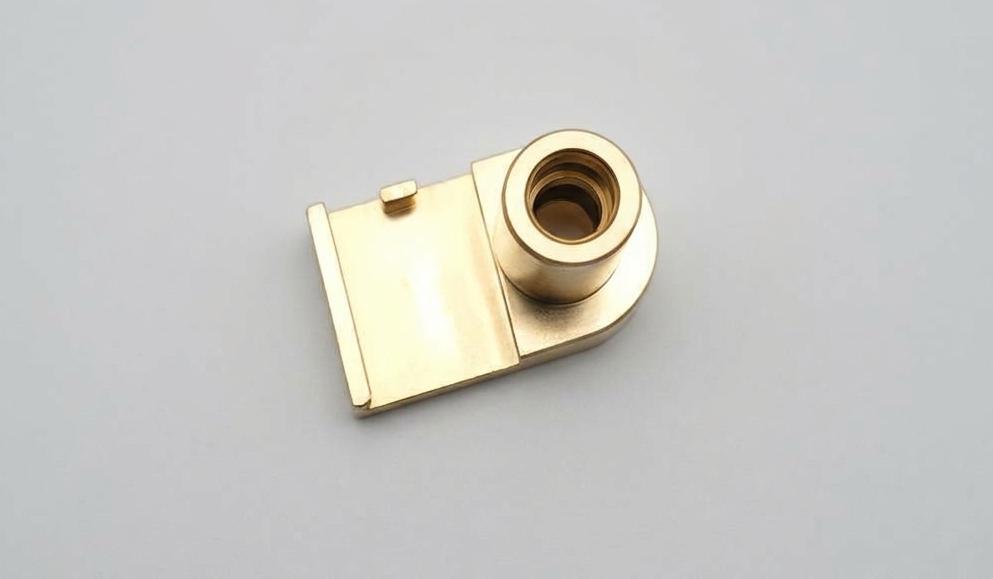
CNC Machined Brass Precision Shaped Connector Base
- Material: Brass
- Size: 7.5X12.5X11.8 mm
- Process: CNC Machining
- Surface treatment: None
This is a precision shaped connector block made of brass, used as a connection component in equipment. It combines a flat base with a stepped boss sleeve in one piece. The sleeve has a through bore, and the base carries a locating boss and a slot.
Brass gives the part its golden color along with good electrical conductivity, thermal conductivity, low friction, and corrosion resistance. Parts like this are commonly used in hydraulic, pneumatic, instrumentation, or electrical equipment, where they handle locating, support, fluid passage, or electrical connection. Brass has a low friction coefficient and does not rust easily, so assembly feels smooth.
Process flow: Brass bar stock is turned, milled, and drilled in a single CNC setup, then deburred, cleaned, and given a final inspection.
Machining Challenges
Brass is ductile, so it tends to stick to the tool and produce stringy burrs. Chips do not break easily and can wrap around or adhere to the cutter, which hurts surface quality.
The thin-wall sleeve is prone to vibration. Vibration makes the bore size and roundness unstable.
The corner where the base meets the sleeve tends to form stress burrs.
The shaped geometry does not tolerate re-clamping. A second setup can introduce positioning error, which directly affects hole position and geometric tolerances.
How It’s Managed
| Issue | Approach |
| Tool sticking and stringy burrs | Sharp, large-rake tools; high spindle speed with a shallow depth of cut; plenty of coolant |
| Thin-wall sleeve vibration | Process support added at the sleeve to reduce chatter marks |
| Corner burrs | Corner relief radii left at the base-to-sleeve transition to reduce burr formation |
| Re-clamping error | Fixturing optimized so most features are completed in one setup, minimizing repeat positioning error |
| Residual burrs | Fine ultrasonic deburring after machining |