
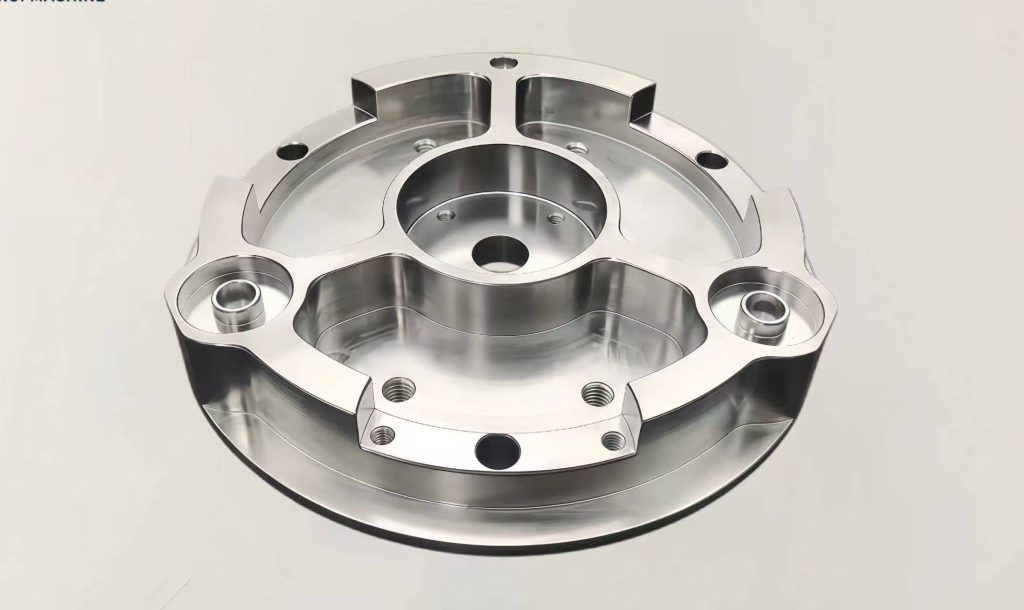
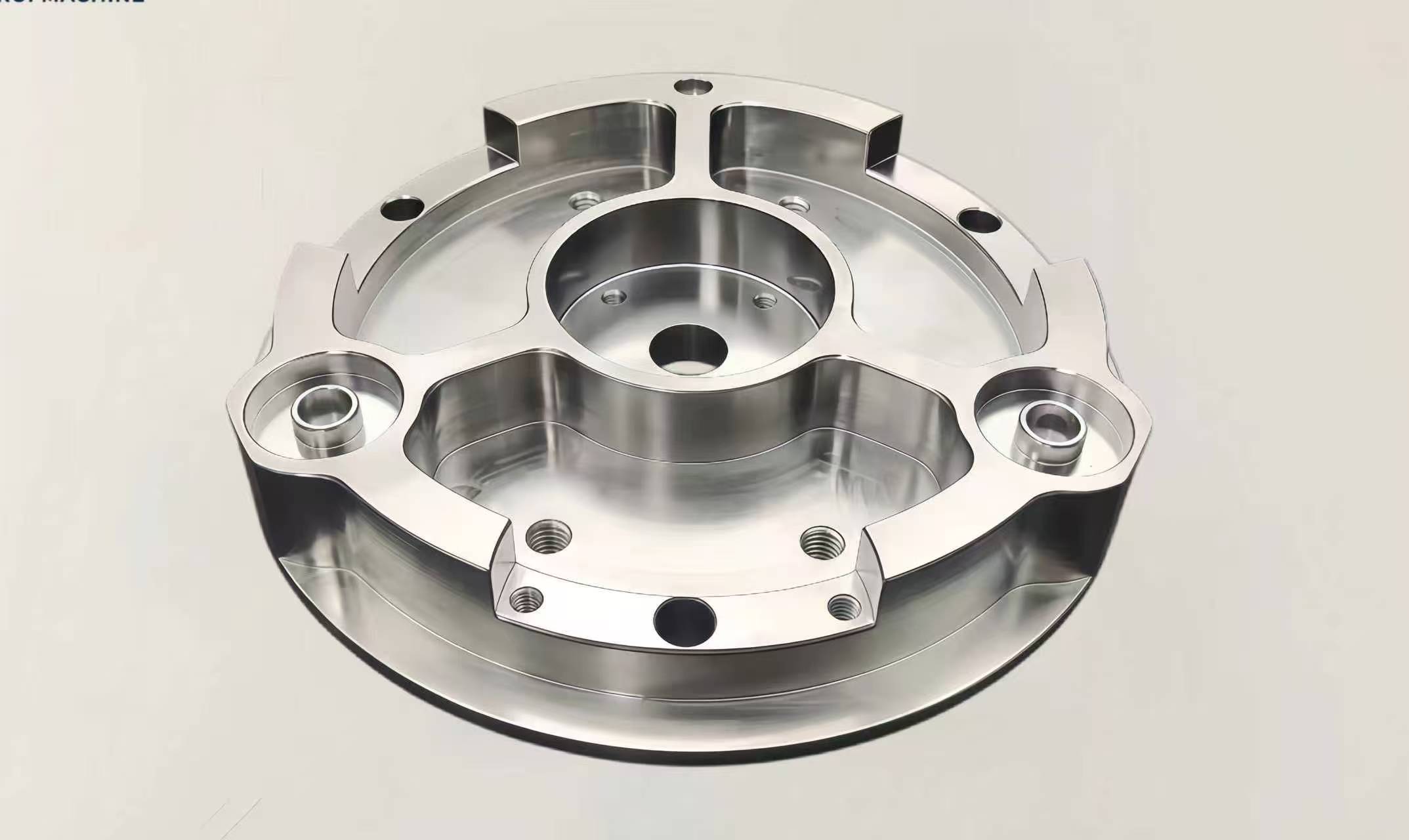
SS304 Stainless Steel CNC Machined Part
- Material: SS 304
- Size: Ø133X21 mm
- Process: 3-Axis CNC Machining
- Surface treatment: None
SS304 austenitic stainless steel is the most widely used grade in its family, valued for reliable corrosion resistance and consistent mechanical properties. It shows up regularly in fluid handling equipment, chemical processing components, and automation assemblies. For a part that may be in direct contact with fluids or chemical media, 304’s corrosion resistance means no surface coating is needed — the bare material holds up on its own.
The Core Challenge: Hollow Milling and Disc Warping
The real difficulty with this part isn’t the geometry — it’s what happens inside the material during machining. The disc face has extensive hollow pockets, which means a significant amount of material is removed by milling. As that material is progressively cut away, the internal stresses that were locked into the stainless steel during its original forming begin to release unevenly. That uneven release pushes the disc face out of flat. On a 133 mm diameter disc only 21 mm thick, even a few tenths of a millimeter of warping can push the face planarity outside the ±0.04 mm tolerance requirement.
This is one of the most common and difficult-to-control problems in stainless steel machining — the issue isn’t the cutter missing its target, it’s the workpiece moving during the process.
How It’s Managed
| Stage | Approach |
| Rough milling | Layered cuts across all hollow areas — no deep single passes, keeping per-cut stress release small and gradual |
| Stress relief rest | Part is set aside after rough machining to allow residual cutting stress to stabilize naturally |
| Finish clamping | Multi-point flexible support fixture with low clamping force — prevents the clamping itself from introducing new distortion |
| Finish cutting parameters | Small depth of cut, high spindle speed, light passes — each cut disturbs the stress state as little as possible |
| Final datum face | A dedicated final pass refines the reference face across the whole disc, bringing warpage within tolerance |
The logic of this sequence is to let the stress release first, then machine in a stabilized state — rather than trying to achieve flatness while the part is still working against itself.
Applications
Bare SS304 disc components without surface treatment are well suited for:
- Transfer flanges and flow distribution discs in automation equipment
- Sealing mating parts in fluid or chemical pipework
- Internal structural components in equipment with cleanliness requirements
In these environments, 304’s native corrosion resistance is sufficient. Skipping the surface coating also eliminates any risk of coating particles entering and contaminating the fluid path.