
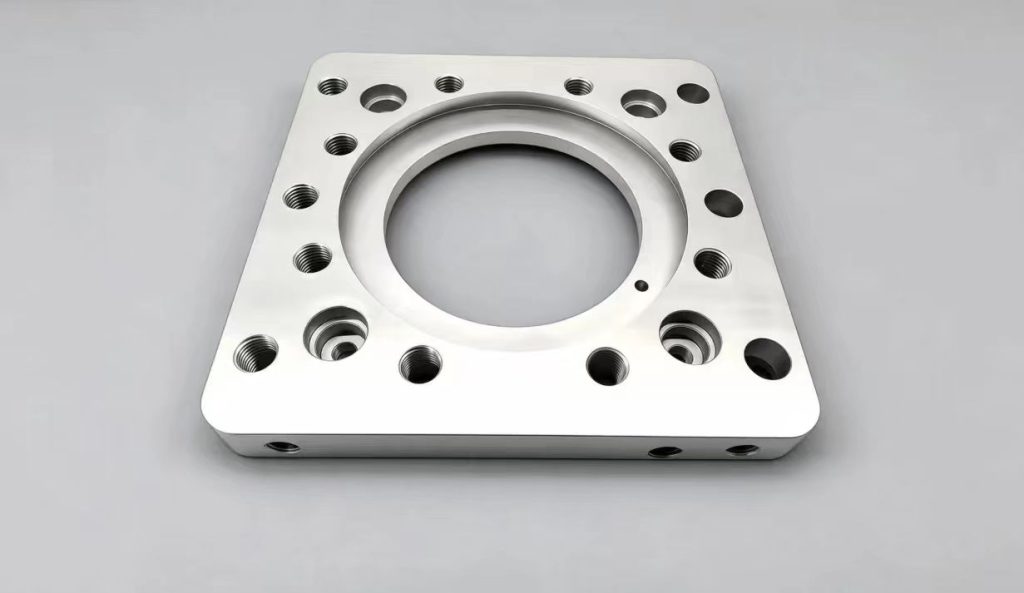
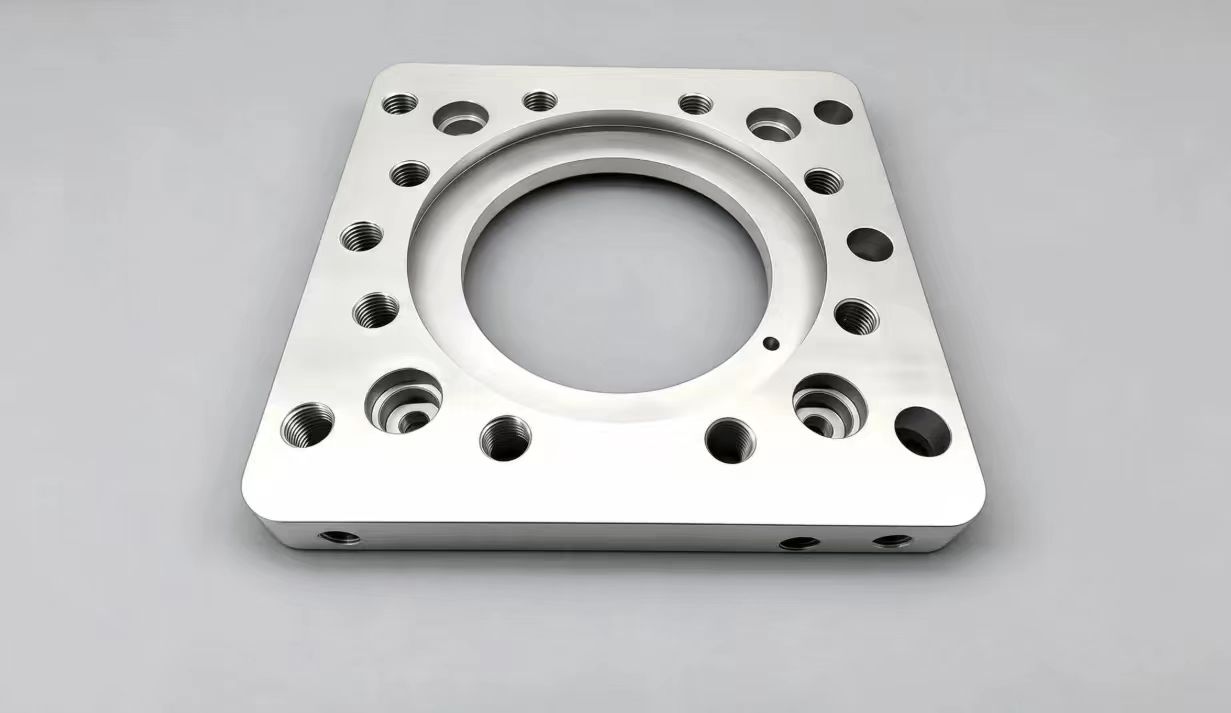
Stainless Steel Square Flange Connection Plate
- Material: SS 304
- Size: 220X220X25.5 mm
- Process: CNC Machining
- Surface treatment: Glass Bead Blasting
The Part at a Glance
This is a square stainless steel flange connection plate, precision machined on CNC equipment. A large through-hole with a stepped sealing shoulder sits in the center, and mounting through-holes and counterbores in several sizes are spread evenly around it, so the plate can be aligned and bolted down.
The surface is glass bead blasted. This step relieves stress left by machining and gives the plate an even matte look, along with good rust resistance.
Four Places Where Things Can Go Wrong
| Where it can go wrong | Why it happens | How we handle it |
| Burrs on hole walls and step faces | 304 stainless is ductile and sticky, so material welds onto the cutting edge as a built-up edge, and surface quality becomes inconsistent | Coated tools made for stainless steel, slower cutting speed, higher feed and cooling, and plenty of coolant |
| Warped sealing face | The plate is 220 mm across but only 25.5 mm thick, a large thin-walled plate that bends under cutting force and clamping stress | Work in stages: rough machining → stress relief → finish machining; multi-point flexible support in the fixture, so no single point is clamped hard |
| Out-of-tolerance hole positions | With many holes on one plate, tight hole spacing and coaxiality, positions can drift as the holes are machined one by one | Pre-drill first, then enlarge and ream; locate with a fixture and machine in a symmetrical order so cutting stress stays balanced |
| Damage from blasting | Wrong blasting settings can round off edges, ding the sealing step, and change dimensions | Mask the sealing step and precision mating faces, choose the right bead size, control blasting pressure and distance, and re-check size and flatness afterward |
Where It’s Used
It is mainly used for sealed connections in vacuum chambers, fluid piping, and automation equipment. The center step works with an O-ring to seal, while the bolts around the edge lock the joint. You will find it in hydraulic and pneumatic systems, test fixtures, medical devices, and new-energy equipment, anywhere a pressure-tight, corrosion-resistant seal is needed.