
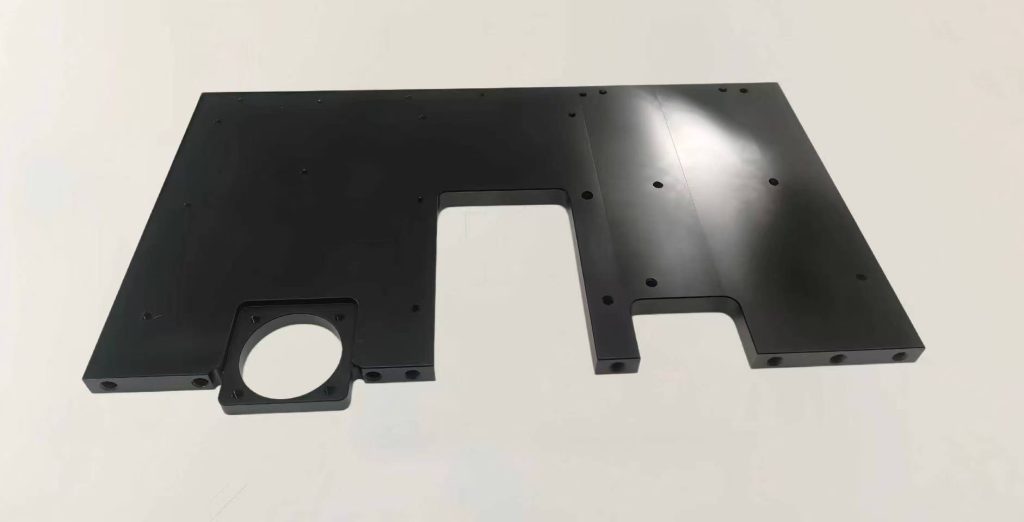
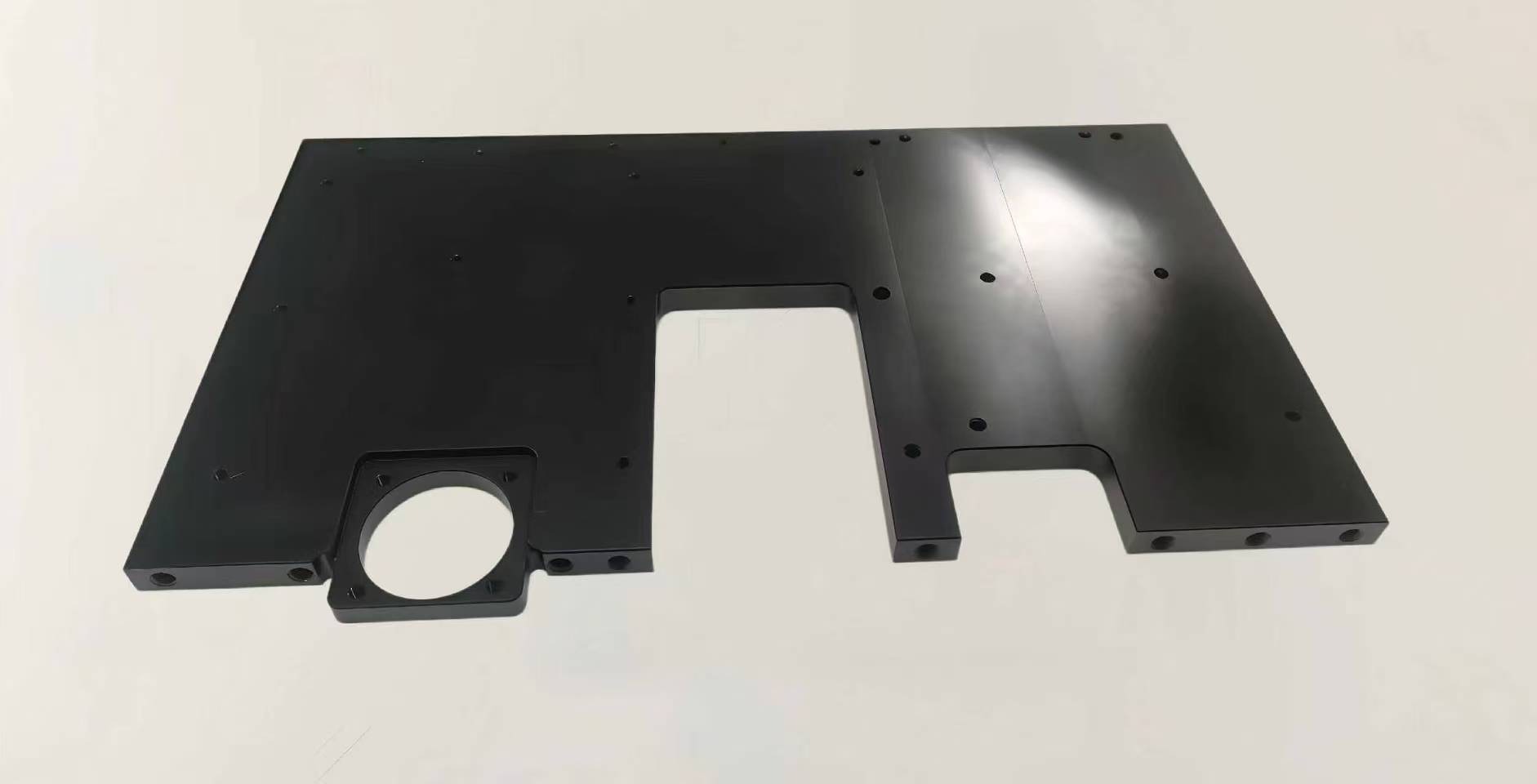
Aluminum CNC Machined Part with Black Anodizing
- Material: AL5083
- Size: 285X10X171 mm
- Process: 3-Axis CNC Machining
- Surface treatment: Black Anodizing
AL5083 is among the highest-strength grades in the aluminum-magnesium alloy family, with good corrosion resistance, reliable weldability, and stable performance at lower temperatures. Compared to 6061, 5083’s strength doesn’t depend on heat treatment aging, which means the material’s properties are more consistent across the cross-section — an advantage when dimensional stability during machining is a priority. At 285X171 mm with only 10 mm of thickness, this is a large, thin workpiece, and that combination sets the difficulty level from the start.
The Challenge: Large Thin Plate + Massive U-Shaped Cutout
A thin plate already lacks rigidity. Adding a large U-shaped cutout removes even more material from the interior, further weakening the overall structure. This creates two overlapping problems that both need to be addressed:
- Overall warping: Once the cutout is machined and residual stress releases unevenly, the plate can bow across its length, pushing flatness beyond the ±0.05 mm tolerance
- Vibration during cutting: With reduced rigidity around the cutout area, the plate is prone to chattering under the cutting tool, which degrades surface finish and throws off hole position accuracy
For a part that needs to hold both overall flatness and dense hole-pattern positional accuracy simultaneously, both problems have to be managed together — handling one while ignoring the other won’t produce an acceptable result.
How It’s Managed
| Stage | Approach |
| Post-roughing rest | Part is set aside after rough milling to allow internal stress to release before finish machining begins |
| Finish clamping | Vacuum chuck with multi-point even suction — low, distributed clamping force that avoids introducing new distortion |
| Finish cutting parameters | Small depth of cut with high spindle speed — reduces cutting force per pass and minimizes vibration excitation on the thin plate |
| Final flatness correction | A full-plate finish milling pass at the end brings the entire surface back into spec uniformlyBlack Anodizing |
Black anodizing builds a dense, integral oxide layer on the aluminum surface, adding corrosion protection and a uniform deep-black appearance. For carrier plates used inside automation equipment, the matte black finish does more than protect — it also reduces surface reflectivity, which matters when the part is used near vision inspection cameras or photoelectric sensors where stray reflections from a bright surface could interfere with detection performance.
Applications
- Mounting plates for robotic arm assemblies
- Frame base plates for automated production lines
- Carrier plates for linear motion modules
- Fixture substrates for inspection and testing equipment