
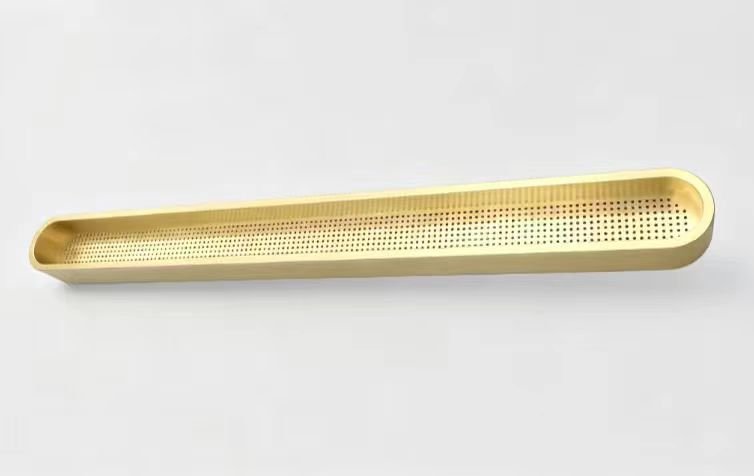
CNC Machined Brass Part
- Material: H62 Brass
- Size: 255.6*24.6*17.5 mm
- Process: 3-Axis CNC Machining
- Surface treatment: None
Why H62 Brass
H62 is one of the most widely used grades in the copper-zinc brass family, with a copper content of around 62%. It combines reasonable strength, excellent thermal conductivity, and better machinability than pure copper. For a part designed to distribute airflow and dissipate heat, the material’s ability to transfer heat efficiently is directly tied to how well it does its job.
Compared to aluminum alloys, brass offers distinct advantages in certain heat management and flow-guide applications.
| Property | H62 Brass |
| Thermal conductivity | Approx. 110 W/(m·K), strong heat transfer performance |
| Strength | Tensile strength ~380-450 MPa, higher than most common aluminum alloys |
| Machinability | Good cutting behavior, suitable for precision CNC milling and small-diameter drilling |
| Surface characteristics | Natural antimicrobial properties, suitable for use inside clean equipment |
| Corrosion resistance | Reliable in dry environments without additional surface treatment |
Part Structure
This part is machined entirely from a single billet, no welding, no assembly joints. A few structural details stand out:
- Elongated concave channel: closed with rounded ends at both sides, forming a uniform passage for airflow or cooling media
- Array of φ1 mm micro-holes along the channel floor: evenly distributed across the base, providing uniform flow distribution and heat dissipation or ventilation; small diameter, high count, dense layout
- Single-piece milled construction: no seams or welds, which ensures consistent channel geometry and reliable airtightness
Those φ1 mm holes are where the manufacturing difficulty concentrates. Drill bits at this diameter have very little rigidity. They’re long relative to their diameter, which makes them highly sensitive to feed rate and cutting conditions. Any variation in feed, chip clearance, or spindle load can snap the bit.
Once a broken drill is lodged in a hole, the entire part is typically scrapped. Managing this requires precise control over spindle speed, feed rate, and pecking rhythm for every single hole, with no margin for error across the full array.
Applications
Structurally, this part functions as an even-flow heat dissipation and airflow guide component. It fits naturally into small equipment interiors where thermal management or airflow organization is needed:
- Heat dissipation guide strips inside small electronic devices or industrial control modules
- Uniform ventilation baffles within precision instrument enclosures
- Cooling channel components for industrial sensors or optical modules
- Compact thermal management structures where reliable conductivity and tight packaging matter
Leaving the surface untreated is a deliberate choice for these environments. In dry, clean equipment interiors, H62 brass offers adequate corrosion resistance without any coating. The bare material surface also allows for more direct heat transfer without an insulating layer in between.