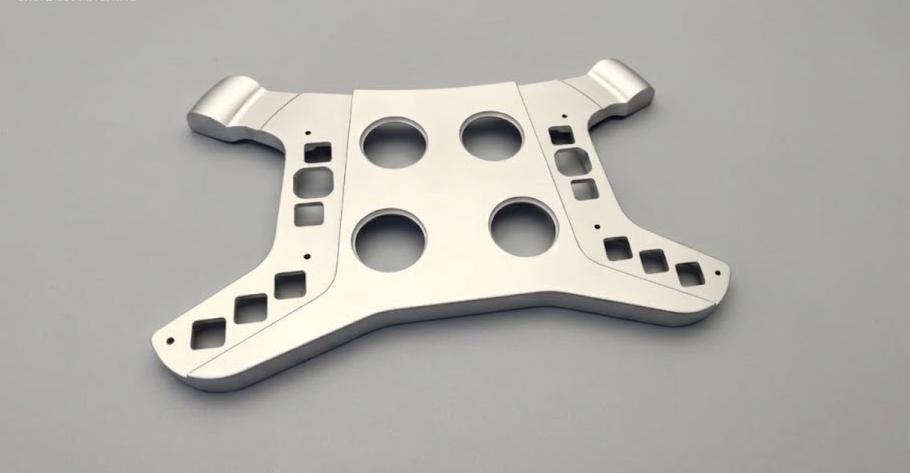
CNC Machined Multirotor Center Frame Plate
- Material: AL 6061-T6
- Size: 281.744X180.526X21.400 mm
- Process: CNC Machining
- Surface treatment: Clear Anodizing
The Process in Brief
This plate begins as an aluminum sheet blank, and the first step is a stress-relief pre-treatment. On the CNC machining center, we then rough mill the outline and the stock on both faces, and finish machine the four large round holes in the middle, the arrays of square holes on both sides, and the small locating holes. The curved support surfaces at both ends are milled as well. Both faces are deburred and polished, and the plate is finished with clear anodizing.

Why This Plate Is Not Easy
- The plate is thin and has a lot of cutouts. Once the internal stress is released by cutting, the plate can easily warp.
- The left and right wings must be symmetrical. Holding symmetry in both hole positions and outline is hard.
- A thin plate marks easily when clamped. Slightly too much clamping force leaves dents on the surface.
- Hole edges on thin walls tend to chip. Clear anodizing is also very sensitive to the surface, and any unevenness can show up as color variation.
How We Solve It
| Problem | Approach |
| Plate warping | Incoming stock is stress relieved ahead of time so the internal stress is released before machining |
| Clamp marks | Vacuum chuck fixturing is preferred, together with low-pressure support stops to avoid dents |
| Heat distortion from cutting | Layered climb milling with a shallow depth of cut and low feed to keep cutting heat down |
| Left-right symmetry | Locating pins establish the datum when the plate is flipped, which keeps both sides symmetrical |
| Chipped edges and color variation | Careful deburring after finishing, and tight control of the anodizing bath parameters to reduce color variation |
Where It Fits
Multirotor drone center frame plates, mounting base plates for model aircraft power units, lightweight support plates for mobile robots, and weight-saving adapter plates for automation equipment.