
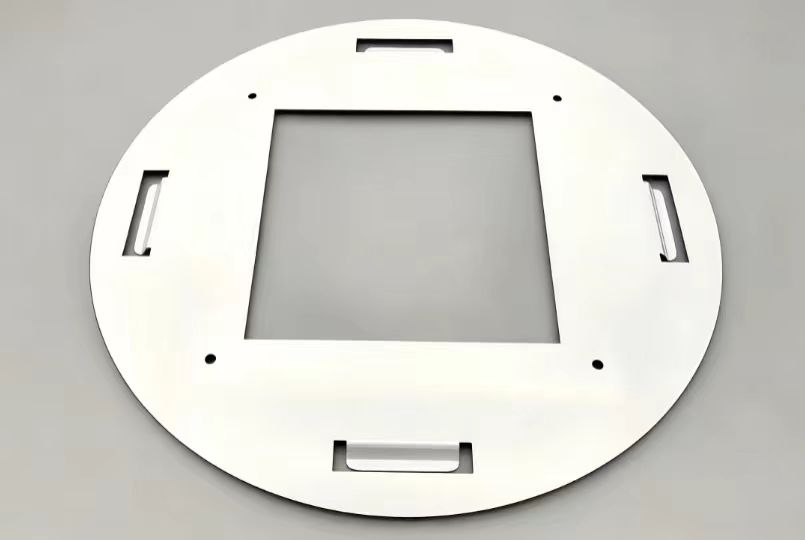
Q235 Steel Part with White Powder Coating
- Material: Q235 Steel
- Size: D254*6.08 mm
- Process: Laser Cutting + Sheet Metal Forming and Bending
- Surface treatment: White Powder Coating
Laser Cutting + Bending: The Standard Sheet Metal Route
The production sequence for this part is straightforward: laser cut first, bend second.
| Step | What It Does |
| Laser cutting | Fiber laser cuts the outer circular profile, central square cutout, four elongated bend slots, and all locating holes in a single pass |
| Sheet Metal Forming and Bending | Four slot positions are bent downward to form clips or mounting flanges, creating the three-dimensional support structure |
Laser cutting works well here because it’s a non-contact process that produces clean, accurate contours with minimal heat distortion across the plate. For a 254 mm diameter disc with multiple different opening shapes, laser cutting is the most efficient way to complete all the profiling in one step.
The difficulty comes in the bending stage. All four bend slots sit very close to both the central square cutout and the outer edge of the disc, leaving very little clearance for the press brake tooling to operate without interference. In these tight conditions, it’s easy for bends to come out slightly skewed, or for the die to locally deform the plate surface during the pressing motion.
Addressing this requires either custom or modified tooling to fit the available clearance, along with careful sequencing of the bend operations to avoid the tooling from interfering with already-completed bends.
Part Structure and Function
| Feature | Purpose |
| Round flat plate, 254 mm diameter | Provides a stable mounting surface |
| Large central square cutout | Allows cables, lenses, or core components to pass through |
| 4 symmetrical elongated bend slots | Form clips or support legs after bending, securing the device body above |
| Small locating holes across the plate | Screw fastening and positional registration |
White Powder Coating
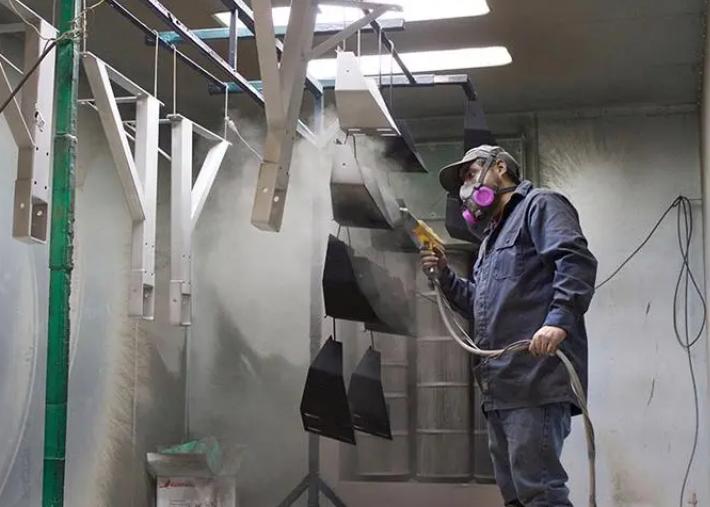
Powder coating is applied as the final surface treatment. Dry powder is electrostatically attracted to the steel surface and then cured under heat, forming a uniform, dense coating that bonds tightly to the base metal. Compared to liquid spray paint, powder coating offers better adhesion, a thicker and more consistent film, and improved resistance to weathering and scratching.
White is a common finish for visible equipment components. It reads as clean and professional, and makes it easy to spot contamination or surface damage during routine inspection.
Applications
- Small automation fixture locating trays
- Equipment panel mounting flanges
- Circular device fixing bases
- Lens mounting brackets for machine vision systems
- Circular adapter plates for lighting equipment and instrument enclosures