
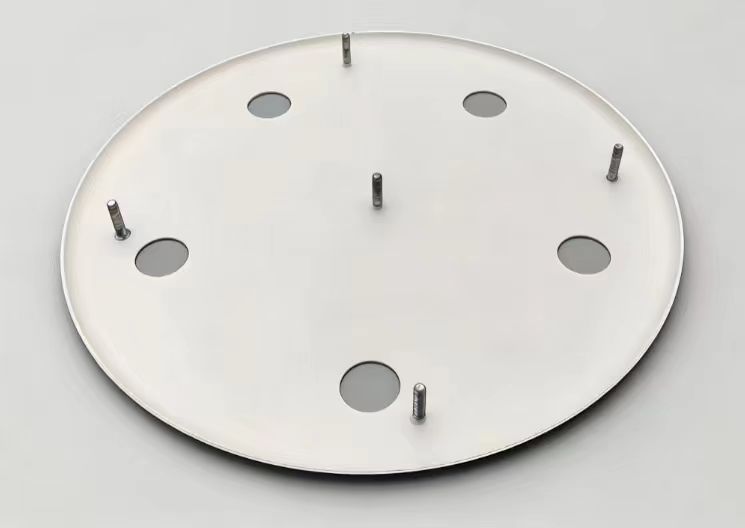
Q235 Steel Stamped and Welded Part with White Powder Coating
- Material: Q235 Steel
- Size: 65.822X169.828X296.525 mm
- Process: Stamping + Welding
- Surface treatment: White Powder Coating
Stamping + Welding: A Two-Process Combination
Production of this part follows three main stages:
| Step | Description |
| Stamp blanking | The oval round-cornered base plate is stamped to shape in batch production, with four mounting through-holes formed in the same operation |
| Stud welding | Six steel positioning studs are cut to length individually, then welded vertically onto the plate face by spot welding or TIG welding, evenly spaced around the perimeter |
| Powder coating | The complete assembly receives a unified white powder coat for surface protection and appearance |
The decision to use welded studs rather than tapped holes directly in the plate is a considered design choice. Tapped holes in sheet metal are limited in thread engagement depth by the plate thickness, which caps the holding strength. Freestanding welded studs can be made to whatever height the application requires, provide a full usable thread length, and generally offer a more secure and reliable fastening point for assemblies with taller stacking height requirements.
The Welding Challenge: Stud Reliability
The most demanding part of making this component reliably is the stud welding step. Small-diameter studs have a limited contact area with the base plate, which concentrates heat input into a narrow zone during welding. That localized heat can cause the surrounding material to become brittle in the heat-affected zone, and under installation torque or assembly stress, studs welded this way can crack and pull free from the plate.
Managing this requires careful attention across the whole process: cleaning and preparing the weld zones before joining, selecting welding parameters that minimize the size of the heat-affected zone, post-weld stress relief where needed, and quality inspection of every stud — checking for cold welds or insufficient fusion before the part moves to surface finishing.
Part Structure
- Oval round-cornered base plate: flat profile with four through-holes for structural or full-assembly fastening
- Six positioning studs: welded vertically onto the plate face, evenly distributed around the perimeter, serving as support pillars and threaded attachment points for the components mounted above
- Fabricated assembly: plate and studs manufactured separately and joined by welding — a clean, batch-production-friendly structure
White Powder Coating and Applications
Powder coating is applied after welding and any final straightening, covering both the base plate and stud surfaces uniformly. Beyond corrosion protection, the white finish provides a clear visual reference in assembly environments, making it easy for operators to verify component placement and fastening status at a glance.
This type of stamped and welded stud base is commonly used in:
- Positioning and mounting bases for small robotic arms or inspection equipment
- Support and positioning bases for automation equipment
- Mounting platforms for instruments and measurement devices
- Internal component mounting plates in industrial control enclosures