

In the world of precision CNC machining, heat is often the silent enemy. Imagine you are working on a batch of small turned parts where the total tolerance is thinner than a human hair. Everything looks perfect on the first few units, but as the afternoon sun hits the workshop or the spindle ramps up to 10,000 RPM, your dimensions begin to drift. Suddenly, that “perfect” part is scrap. For any china cnc machining service, mastering thermal expansion isn’t just a technical detail—it’s the difference between a prototype and a high-performance component.
Why Does Thermal Expansion Hit Small Parts Harder?
When metal gets hot, it expands. It sounds simple, but in cnc small parts manufacturing, the margin for error is nearly zero. Materials like aluminum and brass, which are staples for cnc small aluminum parts, have high coefficients of thermal expansion (CTE).
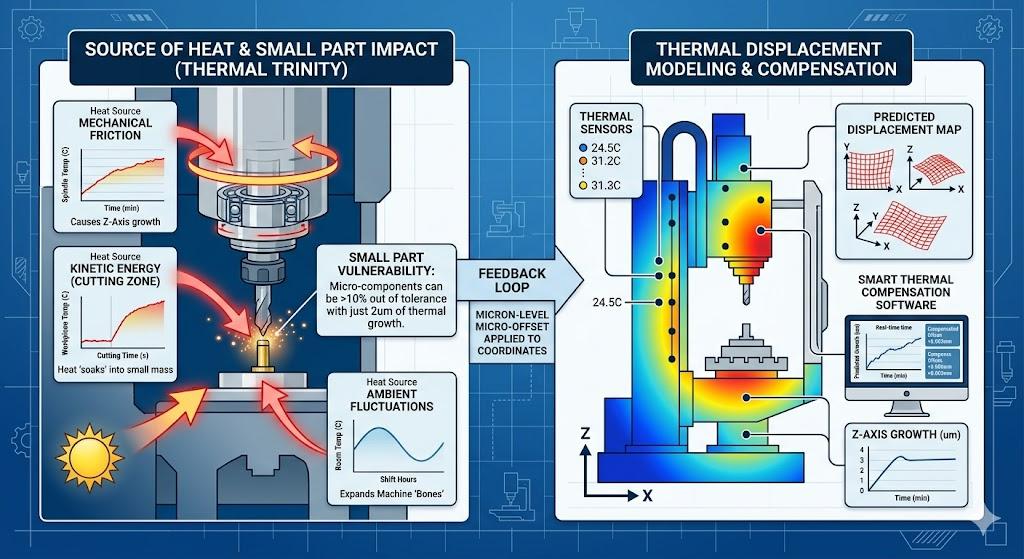
If a 100mm part expands by 0.01mm, it might still fit. But if a 5mm micro-component expands by that same 0.01mm, it represents a massive percentage of your total allowable tolerance. To control this, we first have to understand the “Thermal Trinity”—the three primary heat drivers in a CNC cell:
- Mechanical Friction: The high-speed rotation of the machine spindle and the friction of the cutting tool against the workpiece generate localized “hot spots.” In turning small parts, where RPMs are often pushed to the limit, this heat can be intense.
- Kinetic Energy: The energy required to shear metal is converted into heat. Ideally, this heat stays in the “chip” and is thrown away, but in small parts, the heat often has nowhere to go and “soaks” into the component.
- Ambient Fluctuations: Even the temperature of the factory floor or the sunlight hitting the machine casting can cause the machine’s “bones” to grow or shrink by several microns.
Because small parts have less mass to dissipate this energy, they reach critical temperatures much faster than large blocks of steel. Without a strategic approach to manage this thermal energy, your dimensions will drift as the machine warms up throughout the shift.
At JTR Machine, we don’t just “hope” the parts stay in size; we engineer the environment to ensure they do.
5 Expert Strategies to Beat the Heat
Here is how we maintain micron-level accuracy when milling small parts.
1. High-Pressure Coolant Management
Standard flood coolant isn’t enough for turning small parts. We use high-pressure systems directed precisely at the cutting zone. This does two things: it flushes away chips that carry heat and maintains a constant temperature at the tool-workpiece interface. For materials like stainless steel, which hold onto heat, this is non-negotiable.
The spindle is the heart of the machine. In china cnc milling service, running at high speeds for hours generates massive internal heat. We utilize dedicated oil chillers to circulate temperature-controlled fluid around the spindle and ball screws. By keeping the “bones” of the machine at a constant temperature, we eliminate the “wandering zero” problem.
Sometimes, the way you cut matters more than how much you cool. We often employ High-Speed Machining (HSM) techniques—taking lighter cuts at higher speeds. This ensures that the majority of the heat stays in the “chip” and is thrown away from the part, rather than soaking into the component.
4. Thermal Compensation Software
Modern CNC controllers are incredibly smart. We use machines equipped with thermal sensors that monitor the temperature of the machine castings. The software automatically applies a “micro-offset” to the coordinates in real-time, compensating for the expansion of the metal structure before the error ever reaches the part.
5. Environmental Stabilization
Precision starts with a stable room. We ensure our materials are “soaked” in a climate-controlled environment before the first cut is made. Processing cnc machining small parts in a temperature-fluctuating room is a recipe for disaster.

Material Expansion Comparison Table
Different metals react to heat differently. Understanding these traits is vital during the design phase.
| Material | Thermal Expansion Rate | Machining Difficulty | Best Application |
| Aluminum (6061/7075) | High | Easy | Aerospace, Electronics |
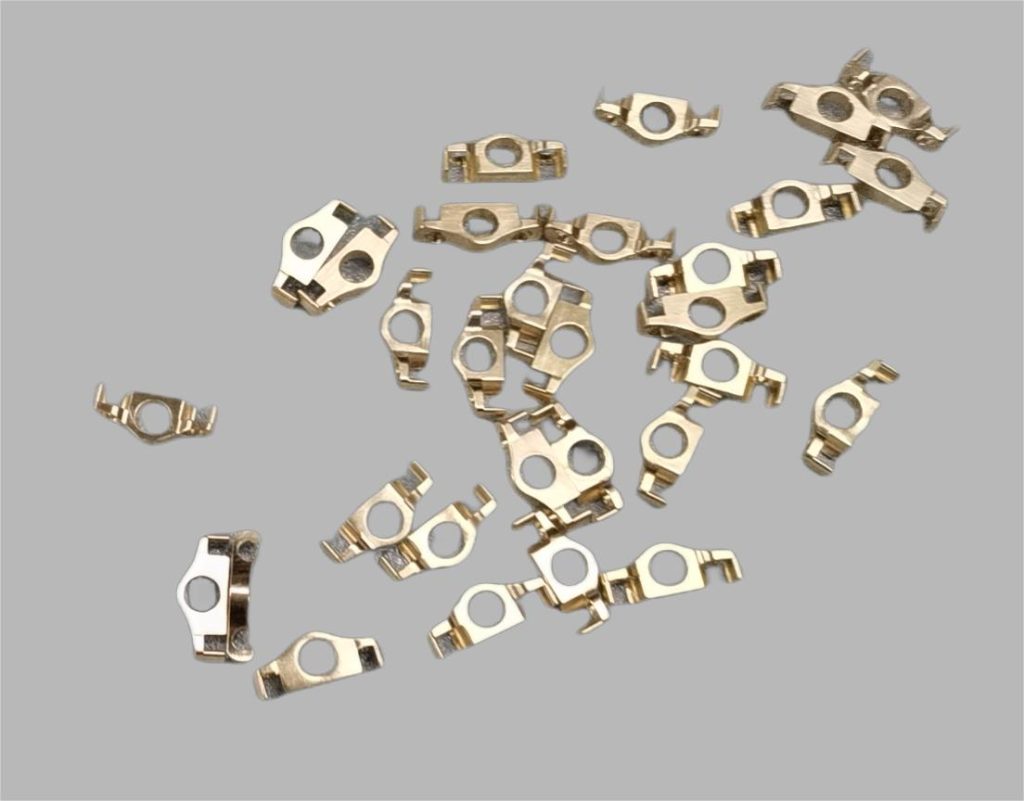
| Brass / Copper | High | Easy | Connectors, Small Pins |
| Stainless Steel (304/316) | Medium | Moderate | Medical, Marine |
| Titanium | Low | Hard | Surgical Implants |
Bringing it All Together: Precision That Lasts
Controlling heat is a full-time job. Whether you are looking for cnc turning china for a few prototypes or china cnc machining for a massive production run, you need a partner who understands that a few degrees can change everything. At JTR Machine, we’ve spent years refining our process so that your last part is just as precise as your first.
Ready to see what real precision looks like? If you’re struggling with tight tolerances or need advice on the best material for your next project, we are here to help. Upload your technical drawings (STEP, IGES, or PDF) for a comprehensive DfM review. Let’s talk about your project and get you a competitive quote for your cnc small parts manufacturing needs today.