

Die casting and stamping are two widely used metal manufacturing processes, but they serve different production needs. Die casting injects molten metal into a steel mold to create complex three-dimensional components, while stamping forms sheet metal into desired shapes using dies and presses. The choice depends on your part geometry, production volume, material, tolerance, tooling budget, and mechanical requirements.
When engineering high-volume metal components, selecting the correct manufacturing process is critical to balancing upfront tooling investments, cycle times, structural integrity, and unit economics. Die casting vs stamping represents one of the most fundamental trade-offs in modern production engineering. While both methods achieve high-volume repeatability, their underlying mechanical principles, material compatibility, and geometric capabilities diverge significantly.
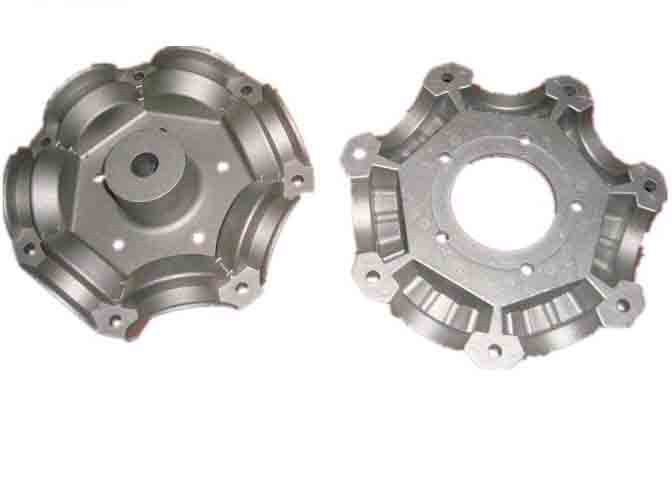
What Is Die Casting?
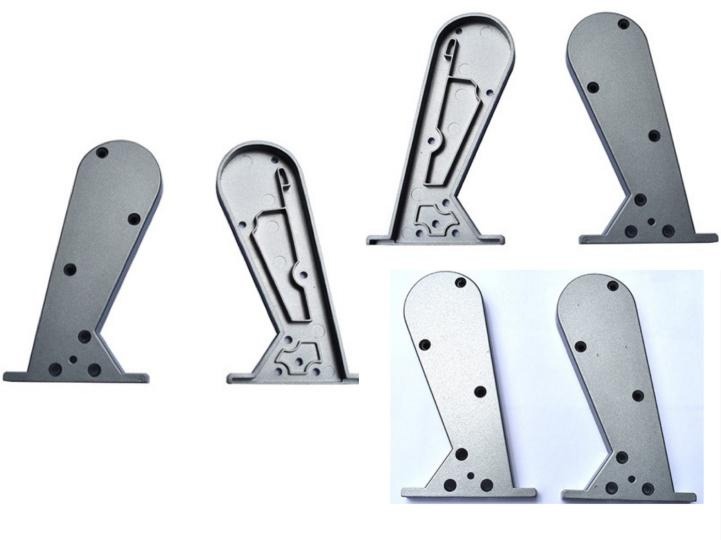
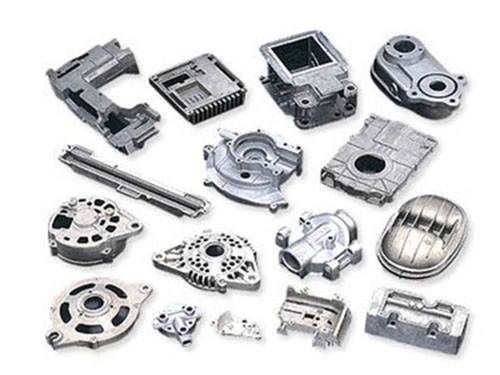
Die casting is a metal casting process that forces molten metal under high pressure into reusable steel molds—known as dies. Engineered for high-volume manufacturing of complex, net-shape or near-net-shape components, die casting delivers exceptional dimensional consistency and intricate geometrical freedom across multiple alloy systems.
Core Die Casting Technologies & Alloys
- High-Pressure Die Casting (HPDC): The industry standard for mass production, utilizing hydraulic clamping units to inject metal at velocities exceeding 50 meters per second under pressures ranging from 1,500 to 25,000 psi.
- Hot Chamber Die Casting: Features a gooseneck metal injection mechanism submerged directly within the molten bath. Highly optimized for low-melting-point alloys like zinc, magnesium, and lead, enabling exceptionally fast cycle times.
- Cold Chamber Die Casting: Molten metal is ladled into the injection cylinder manually or via automated robotic dosing for each shot. Essential for high-melting-point alloys like aluminum and brass, preventing thermal degradation of the injection plunger and sleeve.
- Aluminum Die Casting: The dominant lightweighting solution in automotive and aerospace sectors, offering an optimal strength-to-weight ratio, corrosion resistance, and high thermal conductivity.
- Zinc Die Casting: Provides supreme fluidity, permitting ultra-thin wall sections (down to 0.4 mm), superior impact strength, and effortless electroplating capability.
- Magnesium Die Casting: The lightest structural metal available, prized in portable electronics and aerospace enclosures for its superior electromagnetic shielding (EMI) and damping capacity.
Die Casting Process Flow:
Metal Melting → Molten Metal Injection → High Pressure Filling (1,500–25,000 psi) → Rapid Solidification → Mold Opening & Ejection → Trimming (Flash Removal) → Secondary Machining (Optional CNC) → Surface Treatment & Finishing
What Is Metal Stamping?
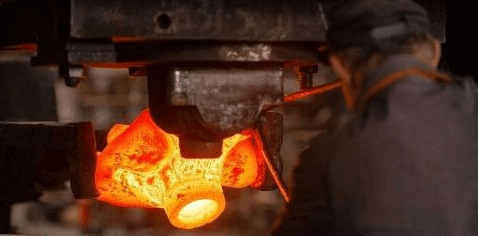
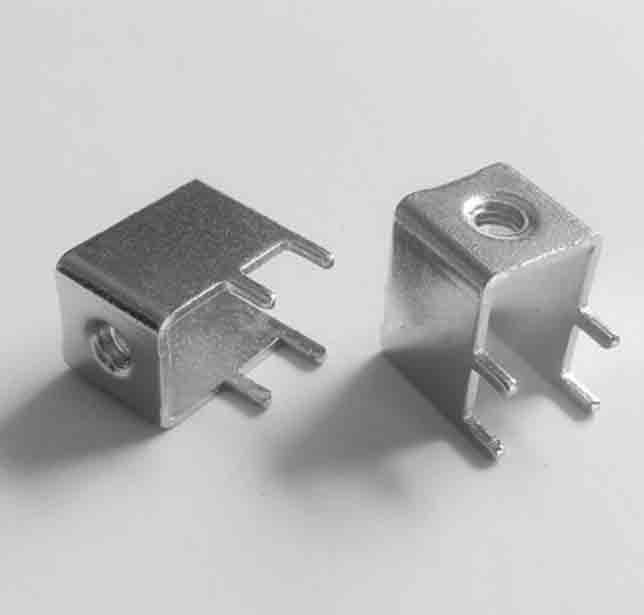
Metal stamping (also known as pressworking) encompasses a wide range of cold-forming manufacturing operations that shape sheet metal coils or blanks into precision components. Utilizing mechanical, hydraulic, or servo-driven presses combined with hardened steel tool sets, metal stamping alters sheet metal through plastic deformation without removing material.
Core Stamping Technologies & Operations
- Progressive Die Stamping: A continuous multi-station setup where a metal strip advances sequentially through cutting, bending, piercing, and coining operations, producing a completed part with every press stroke.
- Transfer Die Stamping: Individual pre-cut blanks are mechanically transferred between separate die stations via robotic fingers or transfer rails, ideal for large, structurally complex automotive and appliance panels.
- Deep Drawing: A sheet metal forming process where a flat blank is pulled into a forming die via a punch, creating symmetrical cup-shaped, cylindrical, or box-like hollow vessels (e.g., fuel filters, beverage cans, battery housings).
- Blanking: The foundational shearing operation that cuts a closed perimeter shape from a raw sheet coil to form the initial workpiece blank.
- Piercing & Punching: Slicing holes, slots, or cutouts out of the metal sheet or formed component.
- Bending & Folding: Angular plastic deformation of sheet metal along a straight linear axis using V-dies, U-dies, or wiping dies.
- Coining: A high-tonnage precision coining operation that applies extreme compressive force to impart fine surface details, coin-like reliefs, or calibrated thickness variations.
Metal Stamping Process Flow:
Sheet Coil Loading → Precision Feeding → Blanking & Shearing → Punching & Piercing → Bending & Form Bending → Deep Drawing (if required) → Quality Inspection & Burr Removal & Assembly
Die Casting vs Stamping: Quick Comparison
To establish an immediate operational overview, the following matrix contrasts the primary technical and economic parameters of die casting vs metal stamping:
| Feature / Parameter | Die Casting | Metal Stamping |
| Raw Material Form | Molten Metal (Ingots) | Sheet Metal Coils / Flat Blanks |
| Product Shape & Geometry | Complex 3D geometries, internal cavities | Flat, formed, bent, or drawn sheet parts |
| Typical Materials | Aluminum, Zinc, Magnesium alloys | Carbon Steel, Stainless Steel, Aluminum |
| Wall Thickness Capabilities | Thin-wall capability (typically 1.0–3.0 mm) | Ultra-thin sheet gauges (down to 0.2 mm) |
| Tooling Cost & Investment | High (machined hardened steel multi-cavity blocks) | High (multi-stage progressive dies and hardened punches) |
| Production Speed & Cycle | Very Fast (100–300 shots/hour depending on size) | Extremely Fast (up to 1,000+ strokes/minute in high-speed progressive setups) |
| Secondary Machining | Sometimes required for tight threads, undercuts | Usually minimal; mostly trimming and tapping |
| Surface Finish Quality | Excellent near-net finish (Ra 1.6–3.2 μm) | Best pristine surface finish (Ra 0.8–3.2 μm rolling finish) |
| Optimal Production Volume | High to Very High (economical from 5,000+ units) | Very High to Mass Production (economical from 10,000+ units) |
| Geometric Complexity | Very High (ribs, bosses, complex internal cores) | Medium (constrained by sheet uniform thickness) |
Process Comparison
Evaluating stamping vs casting requires a deep dive into the mechanical transformation mechanics:
- Material Preparation: Die casting melts solid metal ingots in holding furnaces at temperatures exceeding 650°C (for aluminum). Stamping uncoils cold-rolled or hot-rolled sheet coils, often lubricating the strip to prevent friction scoring during press entry.
- Tooling Architecture: Die casting requires massive, thermally regulated H13 tool steel dies equipped with ejector pin systems and cooling channels. Stamping utilizes progressive or transfer tool sets combining D2 or CPM tool steel punches and dies mounted on heavy-duty punch presses.
- Forming & Solidification: Die casting achieves shape through volumetric liquid filling followed by rapid phase change (solidification). Stamping achieves shape through cold plastic deformation, maintaining uniform wall thickness throughout the formed profile.
- Cycle Time & Throughput: While die casting cycle times range from 20 to 90 seconds per shot, progressive stamping operates at fractions of a second per stroke, yielding immense mass-production output.
- Inspection & Quality Control: Die casting inspections focus on internal porosity (via X-ray or CT scanning), dimensional shrinkage, and flash trimming. Stamping inspections focus on springback, dimensional tolerance drift, burr formation, and crack initiation in drawn radii.
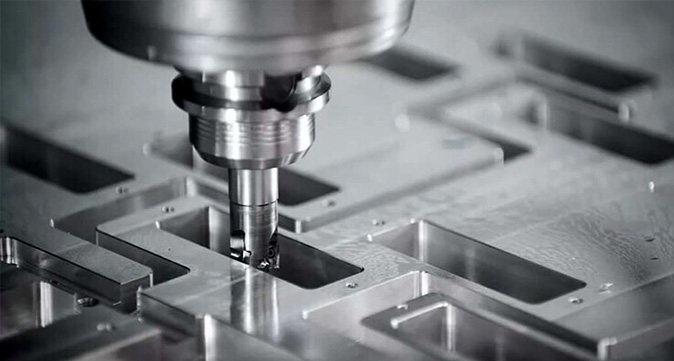
- Secondary Operations: Die cast parts frequently require trimming dies, CNC milling for undercuts, and tapping. Stamped components frequently undergo deburring, spot welding, nut insertion, and protective coating.
Materials Comparison
Material compatibility is a primary boundary condition when deciding between aluminum die casting vs sheet metal stamping.
| Material Family | Die Casting Compatibility | Stamping Compatibility | Engineering Rationale |
| Aluminum Alloys | ✔ Fully Compatible | ✔ Fully Compatible | Die casting uses A380/A360 for fluidity; stamping uses 5052/6061 sheets. |
| Zinc Alloys | ✔ Fully Compatible | Rare / Unsuitable | Zinc possesses exceptional hot-chamber fluidity but lacks sheet ductility. |
| Magnesium Alloys | ✔ Fully Compatible | ✖ Unsuitable | Magnesium sheet is difficult to form cold; high-temp forming is required. |
| Stainless Steel | ✖ Infeasible | ✔ Fully Compatible | Extremely high melting point precludes casting; cold-rolled sheets stamp easily. |
| Carbon Steel | ✖ Infeasible | ✔ Fully Compatible | Steel casting exists, but die casting cannot handle high melting points. Stamping dominates. |
| Copper / Brass | Limited (Specialty) | ✔ Fully Compatible | Copper die casting is limited by thermal shock; brass strip is easily stamped. |
Why Die Casting Cannot Process Steel: Traditional high-pressure die casting machines utilize steel shot sleeves and plungers. Pouring molten steel (melting point ~1,500°C) would instantly weld and erode the injection components, destroying the tooling. Conversely, metal stamping excels with steel because cold-rolled and stainless steel sheets offer excellent room-temperature formability, high tensile strength, and exceptional work-hardening characteristics.
Cost Comparison
Procurement engineering and cost modeling require evaluating total cost of ownership across tooling, raw materials, labor, and machine depreciation.
- Tooling Cost: Both processes demand substantial upfront tooling investment. Die casting molds (multi-cavity hardened H13 steel with slide cores and cooling manifolds) range from $10,000 to $100,000+. Stamping progressive dies range from $8,000 to $80,000+ depending on station count and complexity.
- Production & Machine Cost: High-tonnage die casting cells and automated stamping presses represent major capital expenses. However, stamping’s ultra-fast cycle times dramatically reduce per-part machine amortization at scale.
- Material Cost: Sheet metal coils often generate scrap skeleton waste (up to 20–40% in complex stamping), whereas die casting runner systems and flash are routinely recycled on-site, mitigating net material waste.
- Labor Cost: Modern automated cells (robotic extraction, automated coil feeders) minimize direct labor in both processes, though die casting requires more operator oversight for die maintenance and release agent application.
Volume Suitability Matrix:
- Prototype (1–500 units): Die Casting [★★] | Stamping [★★★★] (via laser cutting / CNC bending)
- Medium Volume (1,000–10,000 units): Die Casting [★★★★] | Stamping [★★★★]
- Mass Production (50,000+ units): Die Casting [★★★★★] | Stamping [★★★★★]
Design Flexibility
Geometrical flexibility is often the decisive factor separating die casting from stamping.
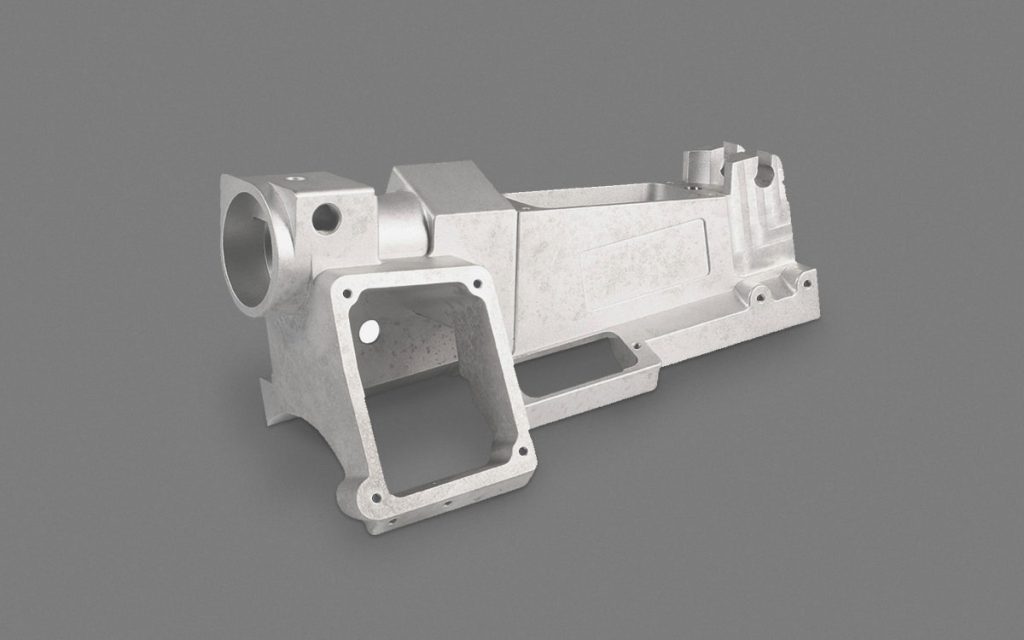
- Die Casting Design Advantages: Enables the creation of complex 3D net-shape features that are impossible in sheet metal. Designers can incorporate internal cavities, structural ribs, mounting bosses, cast-in threads, integrated heat sinks, and variable wall thicknesses within a single component.
- Metal Stamping Design Advantages: Excels at uniform-wall enclosures, brackets, clips, stiffening beads, and deep-drawn vessels. While constrained by uniform sheet thickness, stamping allows for rapid incorporation of bends, folds, embossments, and louvers.
Tolerance Comparison
Precision and repeatability dictate assembly fitness in complex electro-mechanical devices.
| Tolerance Metric | Die Casting | Metal Stamping |
| Linear Dimensional Tolerance | ±0.05 to ±0.15 mm (Standard HPDC) | ±0.02 to ±0.10 mm (High-precision press) |
| Process Repeatability | Excellent (tight statistical process control) | Excellent (minimal tool wear per batch) |
| Surface Roughness (Ra) | Ra 1.6 to 3.2 μm (as-cast) | Ra 0.8 to 3.2 μm (rolling mill finish) |
| Draft Angle Requirement | Required (1° to 3° for easy ejection) | Not required (flat perpendicular walls possible) |
Mechanical Properties
Understanding internal microstructure is vital for structural engineering applications.
- Why Stamped Parts Are Typically Stronger: Metal stamping relies on pre-rolled sheet metal that has undergone extensive hot- and cold-rolling. This mechanical working refines the grain structure, induces work hardening, and yields superior tensile and yield strengths compared to cast structures.
- Porosity in Die Castings: High-pressure injection inevitably traps air and gas bubbles within the molten metal, causing microporosity. While advanced techniques like vacuum-assisted die casting minimize this, die cast parts generally exhibit lower fatigue resistance under cyclic tensile loads compared to wrought stamped metals.
- Ductility & Impact Resistance: Stamped carbon and stainless steels deliver superior impact energy absorption and elongation before fracture, making them the default choice for automotive crash safety structures.
Surface Finish & Post-Processing
Aesthetic appeal and environmental protection depend on finishing compatibility.
Die Casting Finishes: As-cast surfaces exhibit visible gate marks and parting lines. Compatible finishing options include powder coating, liquid painting, chromate conversion coatings, anodizing (specialty alloys), and electroplating. Shot blasting is standard for deburring.
Metal Stamping Finishes: Because stampings utilize smooth mill-finished sheet coils, the underlying surface is exceptionally clean. Common treatments include electroplating (zinc, nickel, chrome), hot-dip galvanizing, passivation (for stainless steel), brushing, and polishing.
Typical Applications Across Industries
Industry-specific deployment patterns highlight where each process dominates:
Automotive Industry:
- Die Casting: Transmission housing cases, engine cylinder blocks, structural shock towers, and EV motor stators.
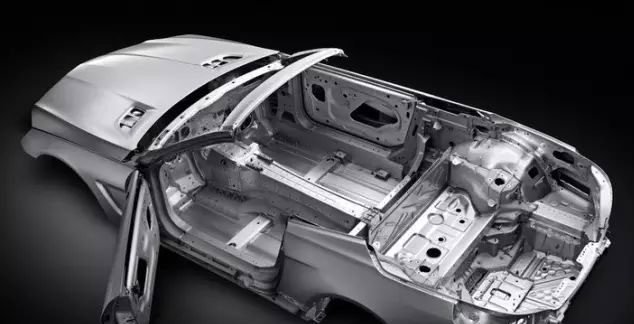
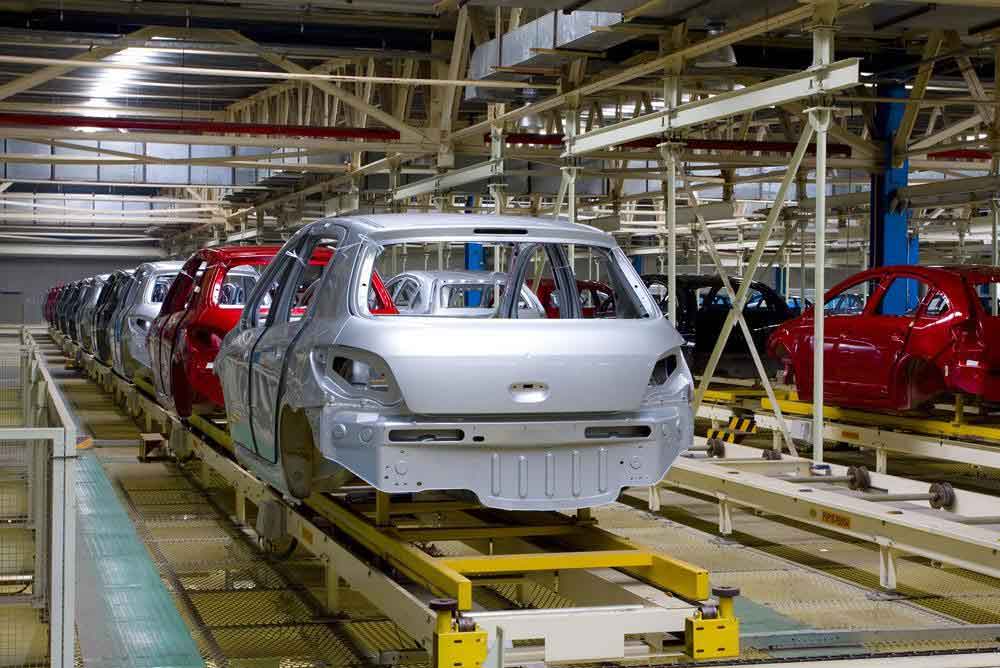
- Stamping: Body panels, chassis reinforcement beams, structural crossmembers, fuel tanks, and exhaust heat shields.
Electronics & Telecommunications:
- Die Casting: Ruggedized server enclosures, handheld device frames, and high-efficiency CPU heat sinks.
- Stamping: EMI/RFI shielding cans, battery contact springs, connector terminals, and chassis trays.
Medical & Aerospace Devices: Die casting produces complex surgical instrument housings and lightweight aerospace brackets, while stamping delivers precision surgical blades, diagnostic tray components, and bracket assemblies.
Advantages and Disadvantages
A balanced summary of operational pros and cons:
| Process | Advantages (Pros) | Disadvantages (Cons) |
| Die Casting | ✔ Complex 3D geometries & thin walls ✔ Excellent dimensional repeatability ✔ High production output rate ✔ Integration of bosses & ribs | ✖ Extremely high initial tooling investment ✖ Internal porosity limits ultimate tensile strength ✖ Limited material selection (non-ferrous focus) |
| Metal Stamping | ✔ Superior mechanical strength & grain flow ✔ Exceptional speed in progressive tooling ✔ Minimal raw material scrap waste at scale ✔ Excellent compatibility with high-strength steels | ✖ Restricted to uniform sheet thickness profiles ✖ Inability to create complex 3D internal cavities ✖ High tooling maintenance costs for progressive dies |
How to Choose Between Die Casting and Stamping
Navigating the engineering decision gate requires a structured evaluation of part geometry, volume, and mechanical duty cycle.
Engineering Decision Tree for Process Selection:
Does the component require a complex 3D shape, internal cavities, or variable wall thickness?
- YES → Choose Die Casting (Aluminum, Zinc, or Magnesium).
- NO → Proceed to step 2.
Is the part manufactured from sheet metal, plate, or strip coils with uniform thickness?
- YES → Choose Metal Stamping (Steel, Stainless Steel, Aluminum sheet).
- NO → Proceed to step 3.
Are high structural fatigue strength and impact resistance paramount (e.g., structural crash members)?
- YES → Choose Metal Stamping.
- NO → Evaluate functional requirements for Die Casting.
Frequently Asked Questions
1. Is die casting cheaper than stamping?
Not necessarily. Die casting tooling is generally more expensive, but for complex 3D parts, it eliminates extensive CNC machining. Stamping is cheaper for flat or bent sheet parts produced in high volumes.
2. Which process is stronger?
Stamped parts are typically stronger because they use pre-rolled wrought metals with refined grain structures and work hardening, whereas die castings can suffer from microporosity.
3. Can aluminum be stamped?
Yes, aluminum sheet alloys (such as 5052 and 6061) are widely used in metal stamping for enclosures, brackets, and automotive panels.
4. Can steel be die cast?
No. High-pressure die casting cannot process steel because the extreme melting temperature (~1,500°C) destroys the steel injection sleeves and tooling.
5. Which process is best for automotive parts?
Both are vital: die casting creates transmission housings and engine blocks, while stamping produces body panels and chassis frames.
6. Is die casting suitable for prototypes?
Direct die casting prototyping is cost-prohibitive due to steel mold expenses. CNC machining or 3D printing is preferred for low-volume prototypes.
7. What production volume is required?
Both processes are optimized for high volume. Die casting becomes economical around 5,000+ units, while stamping often requires 10,000+ units to amortize progressive tooling.
8. Which offers better tolerances?
Both offer excellent repeatability (±0.05 mm), but high-precision progressive stamping typically achieves tighter linear tolerances on sheet profiles.
9. Which process has better surface finish?
Stamping utilizes pristine mill-finished sheet coils, yielding an exceptionally smooth surface, whereas die casting requires secondary deburring and finishing.
10. Can die casting replace machining?
Yes, net-shape and near-net-shape die casting significantly reduce or eliminate secondary machining operations for complex 3D components.