

Why do some die casting projects blow past their tooling budget before a single part is approved, while others make the leap from prototype to mass production with ease? The difference is rarely by accident.
In many cases, the gap usually traces back to decisions made at the design stage. A few millimeters of uneven wall thickness, or a missing degree of draft angle, can set off a chain reaction: accelerated die wear, rejected castings, and costly tooling rework that nobody budgeted for.
This guide breaks down exactly how these two factors affect your die casting dies, what happens when they’re overlooked, and how to get them right from the start.
The Hidden Trap in Die Casting Mould Design: Why Minor Details Drain Your Budget
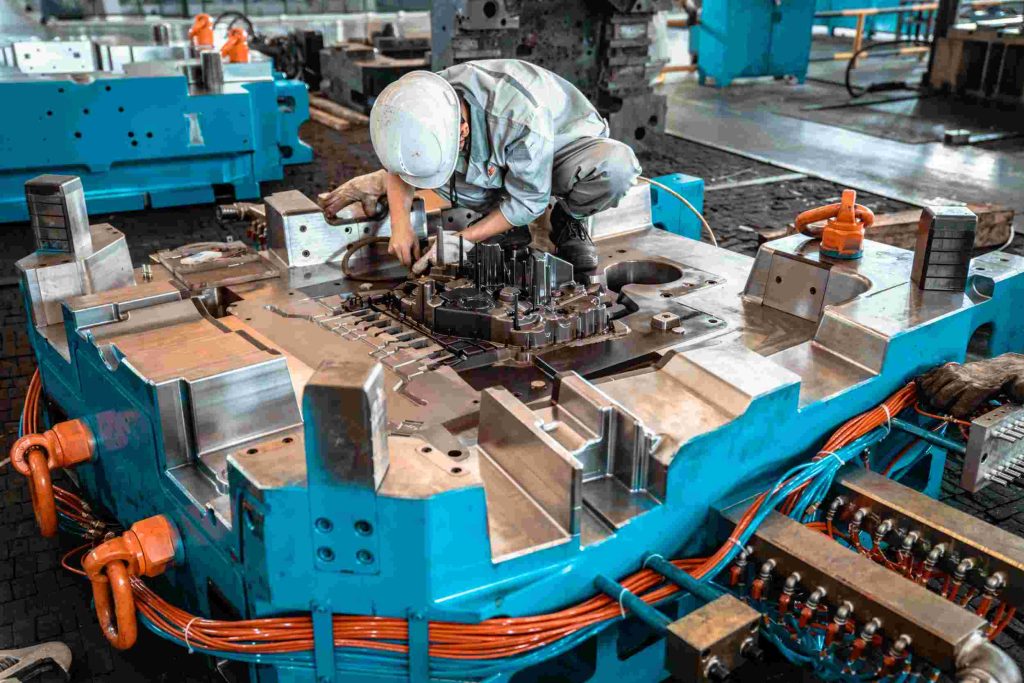
In die casting, most budget overruns are not the result of bad luck. They are the result of geometric mistakes made early in the design process whose repercussions are only paid at the tooling stage. Here are three examples of how that works:
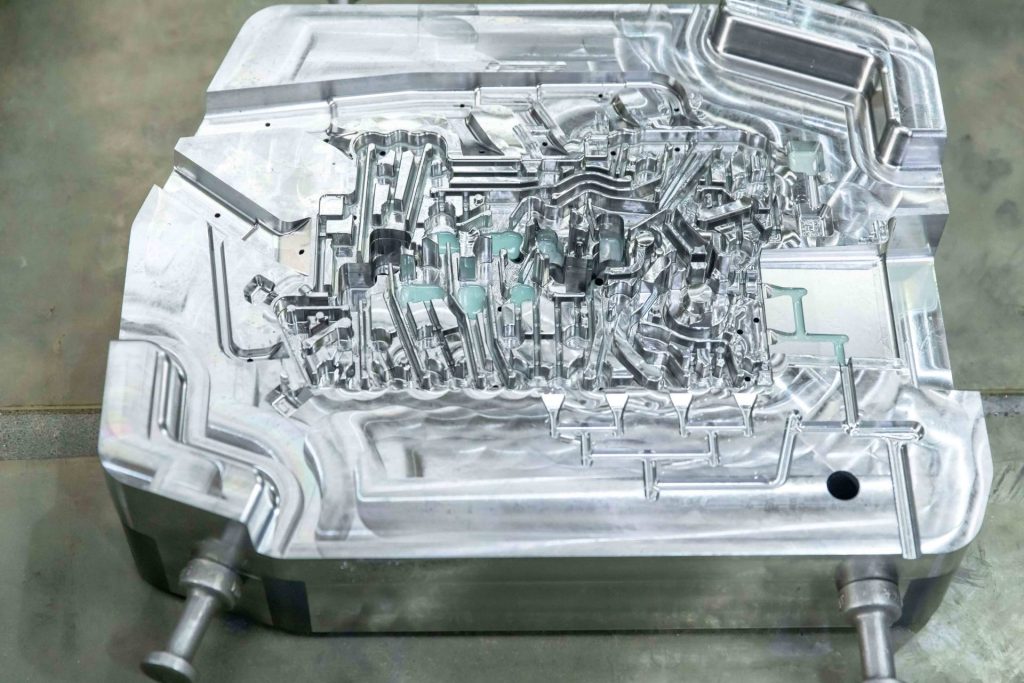
- Tooling Wear and Tear: Sharp changes in shape produce turbulence in the melt flow route. High velocity molten metal cuts the hollow surface in sharp internal corners and abrupt changes of cross section, thus promoting thermal wear and reducing die life often by thousands of cycles.
- Cycle Time Equals Money: Uneven wall sections cool at different rates. Thicker regions retain heat longer, forcing the entire cycle to wait. In high-pressure die casting at scale, even a 3–5 second increase in cycle time compounds into significant added cost per thousand parts.
- The Rework Issue: Modifying die casting dies after they have already been cast is expensive—engineering changes, remachining, sampling and validation costs often outstrip that of an upfront design review and optimization of front end components is almost always more cost-effective.
Mastering Die Casting Wall Thickness: Why Thicker Isn’t Always Better
It’s a common instinct to add material when a part needs to be stronger. In die casting, that instinct can work against you.
The Costly Consequences of Uneven Walls
1. Porosity & Shrinkage
When the melt transitions from a thin section into a thick one, the thin region solidifies first. The thick section continues cooling and contracting, but there’s no longer enough liquid metal to feed it. The result is internal shrinkage porosity. It is invisible on the outside, but catastrophic under load or pressure testing.
2. Warping
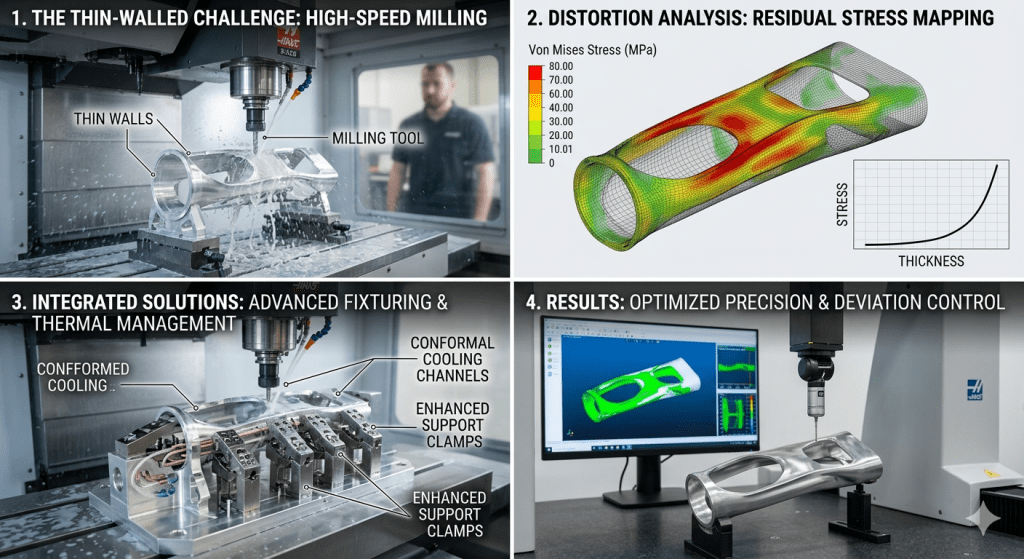
Differential cooling stresses over uneven parts can produce internal residual stresses that result in strain relaxation at different rates as the part cools to ambient temperature, leading to dimensional deformation. Unfortunately, parts that fail inspection typically aren’t reworkable and must be trashed.
3. Material Waste
Beyond a certain threshold, additional wall thickness stops contributing proportionally to structural performance. For aluminum die casting specifically, the relationship between wall thickness and stiffness is not linear — you’re adding mass and cycle time without a real strength return.
Die Casting Wall Thickness Best Practices
- Keep it Uniform: Use the same wall thickness for the whole portion. If a transition is needed, make it gradual with fillets or gussets rather than a sharp step. As a rule of thumb, try to maintain the variance of thickness between ±25% of the nominal wall, wherever practicable.
- Ribs Over Mass: When you need more rigidity, use ribs rather than increasing the overall die casting wall thickness. Ribs add section modulus with minimal added metal — a rib height of 2–3× the nominal wall thickness typically delivers the best stiffness-to-weight ratio.
Wall Thickness Design Reference
| Design Flaw | Consequence in Production | Impact on Tooling Cost | Pro Solution |
| Abrupt thickness changes | Internal porosity, thermal stress cracking | High rework rate to adjust gating system | Use gradual transitions / cores |
| Excessively thick walls | Longer cooling cycle, sink marks | Accelerates thermal fatigue of dies | Hollow out thick sections, add ribs |
| Walls too thin | Incomplete filling (cold shuts) | Frequent die polishing and maintenance | Maintain minimum thickness based on alloy |
Revealing the Die Casting Draft Angle
Draft angle is the slight taper applied to vertical surfaces of a die casting design to allow the solidified part to release cleanly from the die. It’s one of the most underestimated parameters in die casting design guidelines, and one of the most consequential.
Why Zero Draft Costs You Thousands in Tooling Repairs
- Galling and Drag Marks: As the casting solidifies, it shrinks and grips the core. Without sufficient draft, ejection drags the part surface across the die steel, producing galling, scoring, and progressive cavity damage. Each cycle worsens the condition.
- Ejector Pin Failure: When ejection force spikes due to insufficient die casting draft angle, the load transfers to the ejector pins. Pins bend or snap, leading to unplanned downtime, die disassembly, and replacement. In high-volume runs, this is a serious production risk.
- Surface Finish Ruin: Parts pulled from an under-drafted cavity come out with drag lines and torn surfaces. For cosmetic applications such as consumer electronics housings and automotive trim , the entire batch may be non-conforming.
Smart Guidelines for Choosing the Right Angle
1. Alloy Matters: Aluminum alloys have a higher solidification shrinkage than zinc alloys, so they grip cores more aggressively. As a baseline, aluminum die casting typically requires 1°–2° draft on external walls and 2°–3° on internal cores. Zinc can often tolerate 0.5°–1° on external faces.
2. Wall Depth Factor: Draft angle requirements scale with cavity depth. A 50mm deep pocket needs proportionally more taper than a 10mm one to maintain the same release behavior. One-size-fits-all draft values lead to problems at depth.
3. Inner vs. Outer Walls: Internal cores see more gripping force because the casting shrinks inward onto them during solidification. As a result, inner walls consistently require greater draft than outer walls — typically 1°–2° more — a detail that’s easy to miss when reviewing a 2D drawing.
Striking the Perfect Balance in Complex Geometries
Real parts are rarely simple. When wall thickness constraints and draft requirements converge at complex intersections, the design needs a more considered approach.
- Intersections and Corners: At wall junctions, particularly where ribs meet base walls, stress concentration is highest. Generous fillets at intersections distribute thermal and ejection stress more evenly and also improve melt flow, reducing cold shut risk.
- Prototyping Before Mass Production: Before committing to full tooling cost, mold flow simulation(such as Moldflow analysis) can predict where shrinkage, air entrapment, or cold fronts will form based on your current wall thickness and draft geometry. Catching these issues virtually is orders of magnitude cheaper than modifying die casting dies after steel is cut.
- Design for Manufacturability (DFM): The most effective die casting design guidelines aren’t written in a manual, but come from early collaboration between the design team and the manufacturing partner. A DFM review at the drawing stage typically identifies 80% of tooling cost risks before any money is spent on tooling.
Bring Your Die Casting Drawings to Life Without the Guesswork
Optimizing wall thickness and draft angles isn’t just about following rules. It’s about protecting your development budget and keeping your project on schedule. Small geometric decisions made early have a way of becoming expensive problems downstream.
The best die cast parts are almost always the product of engineers and manufacturers talking early, before the design is locked. A problem spotted on a drawing is far cheaper to fix than one discovered in the tool room.
If you’re evaluating your die casting drawings, or you’re not sure whether your current geometry will drive up tooling costs, contact JTR for a free manufacturability review and quote.