

You bend a sheet metal piece to a certain angle and then you release the tooling and the portion opens up a little bit. It won’t stay at the angle you put it at. The difference between what you wanted to do and what you receive is called springback and it is one of the most prevalent sources of dimensional mistake in sheet metal bending.
For the engineer or fabricator, the practical need to know what causes springback in sheet metal bending and how to compensate for it is far more important than the intellectual issue. This guide looks at the mechanics of springback, what influences the amount of it, how manufacturers deal with it, and some frequent myths worth addressing.
What Is Springback in Sheet Metal Bending?
When a force is applied to bend sheet metal the material is deformed in two ways simultaneously. The layers on the outside surface are under tension, whereas the inner layers are in compression. Between the tension and compression zones lies the neutral axis, where the longitudinal strain is essentially zero during bending. When the bending force is withdrawn the elastically deformed part of the material (stressed but not more than the yield point) recovers and forces the part back to its original shape. This incomplete return is called springback.
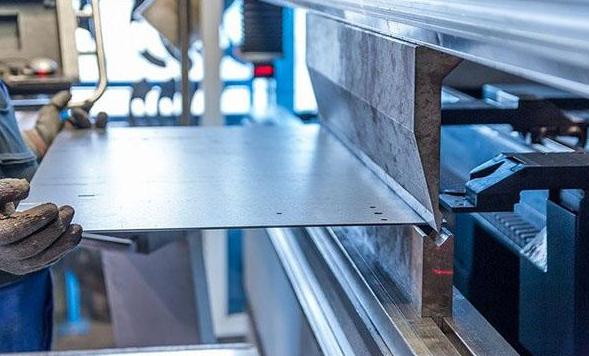
Practically, it looks as an angular difference, the bend angle you applied vs the angle you measure once the item gets freed. If you bend to 90 degrees and the part springs back to 93 degrees, that 3 degrees is your springback.
The crucial point to remember is that springback can never be totally eradicated. Every metal has certain elastic activity and that behavior goes through the bending process. The idea is not to get rid of it, but to foresee it and offset it predictably.
Why Does Sheet Metal Spring Back After Bending?
Several variables influence how much springback occurs. Some are properties of the material itself, some relate to part geometry, and others depend on the bending process being used.
Material Strength and Elastic Properties
In general, the higher the strength of the material, the more springback it will experience, since it stores more elastic energy before being plastically deformed:
- Yield strength: The higher the yield strength, the more stress it can take before permanently deforming (bending) the material. This means more elastic recovery.
- Elastic modulus: Elastic modulus affects how a material elastically recovers, but springback is typically determined by the combined effect of yield strength and elastic modulus rather than stiffness alone.
- Stainless steel vs. mild steel: In practice stainless steel always springs back more than mild steel of similar thickness. This needs to be considered at the design stage and not discovered in production.
Material Thickness
Springback is generally less noticeable in thicker sheets than in thinner ones. In thicker materials, a larger portion of the cross-section undergoes plastic deformation, leaving proportionally less elastic recovery. As a result, thinner sheet metal usually exhibits more noticeable springback.
Bend Radius
Larger inside bend radii increase springback because the plastic deformation is distributed over a longer arc, reducing the permanent set. Tighter bends concentrate plastic deformation more intensely and generally result in less springback. In part design, avoiding unnecessarily large radii is one of the simpler ways to keep springback more predictable and easier to compensate for.
Bending Method
The process chosen for sheet metal bending has a significant effect on how much springback occurs:
- Air bending: The punch doesn’t push the material fully into contact with the die. This is the most versatile strategy yet it gives the greatest springback due to the partial relief of elastic stresses.
- Bottom bending (bottoming): The punch presses closer to the die, increasing plastic deformation and reducing springback. It offers better consistency than air bending.
- Coining: Under a high pressure, the material is squeezed in the die cavity, reducing elastic stress. Springback is very low but tooling wear is higher and the process requires more careful setup.
Grain Direction and Material Variations
The rolling direction of a sheet has been found to alter its bending behavior. Bending at right angles to the grain generally has somewhat different outcomes than bending along the grain. And then material qualities can vary slightly batch to batch, even if the standard is essentially the same. What works for one batch may need to be tweaked somewhat for the next.
These factors do not act in a vacuum. Here’s a basic rundown of how each one normally goes:
| Factor | Typical Effect on Springback | Manufacturing Consideration |
| Material strength | Higher → More springback | Material selection |
| Sheet thickness | Thinner → More springback | Part design |
| Bend radius | Larger → More springback | Tooling design |
| Bending method | Varies by process | Process selection |
| Grain direction | May increase variation | Part orientation |
| Tooling accuracy | Influences consistency | Tool maintenance |
How Manufacturers Reduce Springback?
1. Apply Bend Compensation
The most typical way is to over-bend the piece a little bit, so that after springback the angle settles where it should. The compensation amount is dependent on the material, thickness, bend radius and tooling. There is no one number. In practice, compensation values are built up from production experience with specific materials and geometries and refined over time.
2. Select the Right Bending Process
Choosing between air bending, bottoming, and coining means balancing accuracy requirements against tooling wear and production efficiency. Air bending suits general work where flexibility matters more than tight tolerances. Bottoming is a good middle ground for consistent, accurate results without excessive tooling demands. Coining makes sense when tolerances are strict and part volumes justify the higher tooling investment.
3. Optimize Tooling and Bend Radius
The punch and die geometry should suit the material being processed. A die opening that’s too wide for the sheet thickness increases the effective bend radius and amplifies springback. Keeping bend radii as tight as the design allows, while staying within the material’s bending limits, helps reduce variation.
4. Verify Through Trial Runs
Before committing to a full production run, making sample parts and measuring the actual angles is well worth the time. Machine parameters can then be adjusted based on real measurements rather than calculated estimates. This step is especially valuable when bending a new material or a geometry that hasn’t been run before.
Can Springback Be Predicted Before Production?
Prediction is possible, but it’s better treated as a starting point than a final answer.
Modern CAD/CAM software and bending simulation tools can estimate expected springback based on material data and geometry. These tools have become more capable over the years and often provide a reasonable initial compensation value. That said, simulation accuracy depends on how well the material data matches the actual batch being processed. Generic database values may not fully capture the specific behavior of the material in your facility.
Prototype bending remains the most reliable way to validate simulation results. Running a small number of trial parts, measuring the angles, and comparing them against the predicted values gives you a solid basis for setting production parameters. For experienced fabrication teams, the knowledge built from past production runs is often just as useful as any software output when it comes to setting the initial bend compensation.
Common Misunderstandings About Sheet Metal Springback
Myth 1: Springback Means the Bend Was Done Incorrectly
Springback is not a sign of an error. It is a natural physical response of metal to the release of bending force. Every engineering metal has elastic properties, and all of them will spring back to some degree. Recognizing this as a predictable behavior, rather than a defect, is what allows it to be managed properly.
Myth 2: One Compensation Value Works for Every Material
This is an assumption that will lead to out of tolerance pieces when the materials change. Stainless steel, mild steel, aluminum and high strength alloys will all respond differently, given the identical conditions. Thickness and temper influence springback within the same family of materials. Compensation needs to be matched to the specific material and geometry of the part being made.
Myth 3: More Press Force Always Solves the Problem
Just increasing tonnage and not changing other process parameters is not a dependable cure. Excessive force might result in faster tool wear, damage to the surface of the part, or new dimensional difficulties. The goal is not raw force but controlled, precise, deformation.
Better Bending Starts with Better Process Control
Springback in sheet metal bending is a phenomenon that every fabricator is familiar with. When understood and planned for, it is a manageable part of the process, not a reoccurring problem. Material selection, part design, tooling set-up, and process parameters all play a role, and consistent results come from keeping all of them in view at the same time.
If you have a bending difficulty that is impacting part quality or are searching for a fabrication partner with the hands-on knowledge to do tight-tolerance sheet metal work, contact JTR Machine and tell us about your project.