

Pick the wrong method of fastening early on in a project and you could be left with joints that are almost impossible to maintain, a production line that slows down at the wrong point or connections that loosen under vibration. In many assemblies, engineers need to choose between riveting and bolting, but the better option is not always obvious.
In this guide, we review the differences between these two mechanical fastening methods, applications that are best suited to each, and what to inspect before your design is complete.
Riveting or Bolting: What’s the Difference?
Both are standard mechanical assembly techniques for joining two or more parts together, although they operate in fundamentally different ways.
The process is straightforward: you drill holes, insert a rivet, then deform the rivet on the back side to hold the materials together. This creates a joint that is not supposed to be disassembled. Bolts are based on threaded fastening: the joint is held together by mated thread profiles and a controlled clamping force and the assembly can be undone when required.
In practice, the two approaches differ as follows (see table below):
| Factor | Riveting | Bolting |
| Joint type | Permanent / difficult to remove | Removable |
| Disassembly | Difficult | Relatively easy |
| Vibration | Can be suitable when properly designed | Can be suitable with proper preload and locking |
| Assembly access | Can work well where access is limited | Usually needs access for tightening |
| Maintenance | Less convenient to disassemble | More convenient |
| High-volume assembly | Can be efficient for suitable designs | Can require more assembly operations |
When Is Riveting a Good Fit?
Riveting is good for assembly when the connection is not intended to fall apart. Riveting eliminates the requirement for thread engagement, locking hardware, and the torque control threaded fastening required, for a permanent connection. A typical example is structural brackets, chassis components and sheet metal enclosures.
Another aspect to consider is access surrounding the joint. Blind rivets are convenient for enclosed parts or narrow regions where a wrench cannot get to both faces because only one side of the job needs to be accessible. This is one of the more underestimated benefits of the riveting process, and may frequently make a big difference to the ease of building an assembly.
Automated riveting equipment can be used in high volume production and drive fasteners at a steady speed with very little variance. On sheet metal lines or light structural assemblies this is usually faster than threading and torquing each bolt separately.
For thin sheet materials, rivets can also be useful because they can provide a low-profile joint without relying on high bolt torque that could damage or deform the sheet.
When Is Bolting a Better Fit?
The argument for threaded fastening usually boils down to what happens after the initial assembly. Bolts are the practical solution for a part that needs to come off often for maintenance or inspection, like a cover plate, filter housing or access panel.
You must drill out all the fasteners to remove a riveted junction, which can be time consuming and could damage material nearby. That’s a big negative for anything that’s going to be opened and closed multiple times throughout the product’s service life.
The same concept applies if you expect to replace components. A mechanical assembly that has pieces that wear out or need upgrading is better served by a system that allows for clean disassembly without compromising the remainder of the structure.
Bolts also make it easier to control joint preload. Applying a specified tightening torque can provide a repeatable level of clamping force when the fastener and installation conditions are properly controlled. This is important in gasketed joints, precision alignments and applications where repeatable joint stiffness is a design intent.
Finally, if the design is still under development and the dimensions can be subject to change, bolted joints provide adjustments without scrapping the assembly, which makes them a safer option during development.
What Should You Check Before Choosing?
A few simple checks before choosing a fastening method can prevent costly rework later:
- Will the joint need to come apart? If yes, start with bolting.
- What loads, materials, and joint conditions are involved? Both riveted and bolted joints can handle shear and tension, but the specific load case, fatigue requirements, and joint design need to be considered.
- How much access is available? One-sided access points toward riveting; clear two-sided access keeps both options open.
- How many parts will be produced? For large volumes, automated riveting assembly can offer a real speed advantage.
| Assembly Requirement | More Suitable Option |
| Frequent maintenance | Bolting |
| Permanent connection | Riveting |
| Limited access for assembly tools | Often riveting |
| Repeated high-volume assembly | Often riveting for suitable designs |
| Design still changing | Bolting |
| Easy future replacement | Bolting |
Match the Fastener to the Job
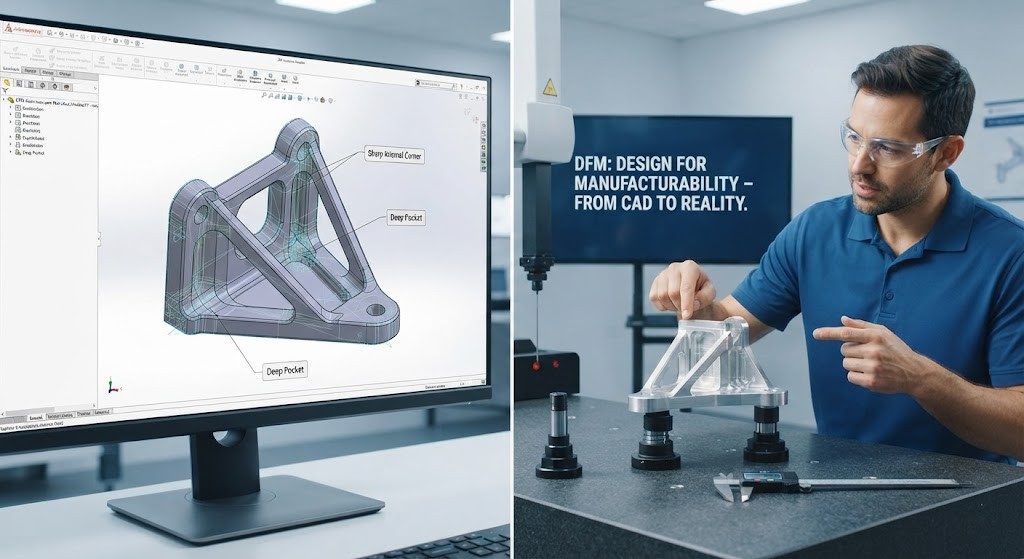
There is no single proper answer to riveting vs. bolting. The best choice depends on what the joint needs to do, how it will be constructed and what happens to it during the service life of the product. Doing things right early avoids expensive modifications later on.At JTR, we work across a range of mechanical assembly methods, from sheet metal fabrication to precision CNC machined components where fastening reliability matters. If you are evaluating assembly options for an upcoming project, contact our team for a free DFM review.